RA V16 N3, Message from the Editor-in-Chief (September – December, 2026)
Keywords:
--Abstract
LATIN AMERICAN JOURNAL OF QUALITY CONTROL, PATHOLOGY AND RECOVERY OF CONSTRUCTION
http://www.revistaalconpat.org
It is a source of satisfaction and joy for the ALCONPAT Journal team to see the publication of the third issue of our sixteenth year.
The objective of the ALCONPAT Journal (RA) is the publication of citable production (basic or applied research, and reviews), documentary research and case studies, related to the topics of our association, that is, quality control, pathology and recovery of constructions.
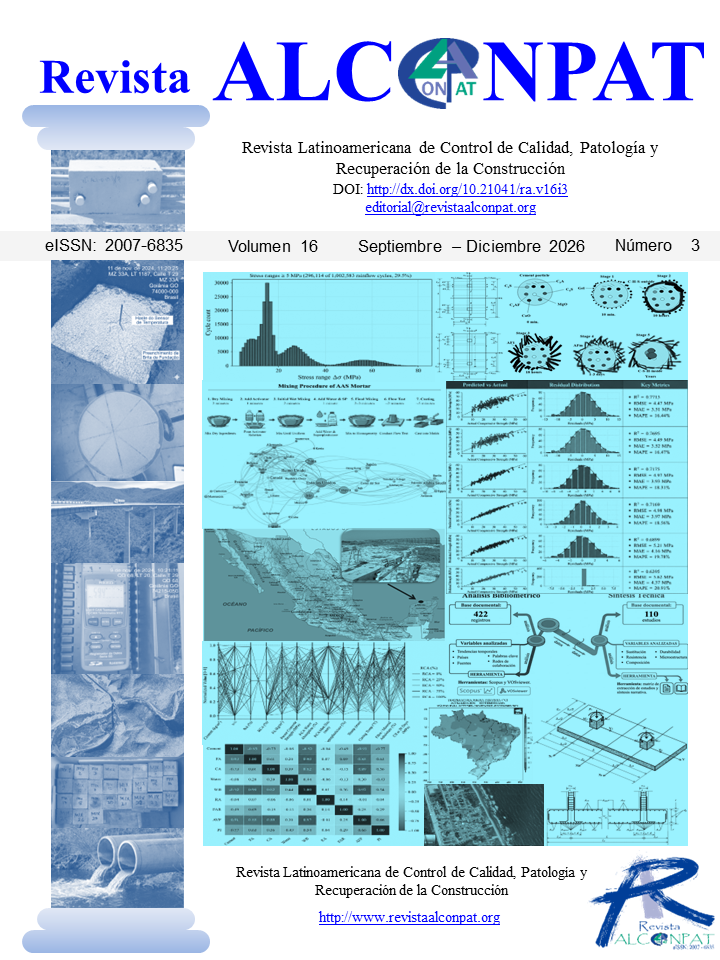
This V16 N3 edition begins with a paper from Mexico, where Pedro Israel Silva Martínez and Alejandro Meza de Luna evaluate the feasibility of using secondary-treated domestic wastewater in concrete production and its chemical-mechanical implications. The methodology consisted of a structured literature review focused on chemical composition, hydration, and mechanical properties. The results show high variability: 59% of the cases reported decreased strength, while others showed improvements depending on pH, salts, and dissolved solids. A unique aspect of this study is the integration of chemical-mechanical analysis beyond conventional classifications. The study concludes that its use is viable under controlled conditions, requiring performance-based approaches to ensure durability and sustainability.
In the second work, L. J. Fernández-Sánchez and colleagues from Ecuador, Cuba and Mexico make a systematic review and evaluate volcanic ash as a supplementary cementitious material in mortars and concretes, emphasizing its applicability to the Ecuadorian context. Indexed studies were analyzed through a bibliometric strategy and a technical synthesis of mechanical performance, durability, and pozzolanic mechanisms. Results show favorable replacement ranges of 10–25%, associated with pore refinement and C-S-H/C-A-S-H formation. However, wider implementation is limited by chemical variability, fineness, Ca(OH)₂ availability, and the need for local characterization. The originality of this review lies in discussing these technical limits in relation to clinker factor reduction. It is concluded that its application requires technical, normative, logistical, and industrial validation.
The third paper in this issue is from India, where Pintu Kumar Yadav and Ajay Kuma develop an explainable machine learning framework for predicting the 28-day compressive strength of recycled aggregate self-compacting concrete (RA-SCC) using particle packing indicators. A dataset comprising 365 mixtures from 102 studies was analyzed using six regression models, with SHapley Additive exPlanations (SHAP) applied for interpretability. The Extra Trees model achieved the highest accuracy (R2 = 0.9724, Root Mean Square Error (RMSE) = 1.19 MPa). The dataset is limited to 28-day strength and excludes admixture effects. The study introduces a combined approach integrating particle packing concepts, multicollinearity assessment, and explainable AI. The results demonstrate that machine learning can reliably predict strength while implicitly capturing packing-related mechanisms.
The fourth article, by Arnulfo Luévanos Rojas and colleagues, comes from Mexico, present the complete design for RCFs (rectangular combined footings), assuming that the contact area with the soil is partially compressed. The formulation is carried out by integration to determine the moments, flexural shearing and punching shearing for all possible cases for footings under biaxial and uniaxial flexion. Numerical studies are presented to determine the design of this type of foundation. The proposed model offers significant savings in concrete and steel volumes compared to the current model, if the resultant force is located outside the central nucleus. Therefore, the proposed model should be used, because it offers better quality in the control of the resources used.
The fifth paper from Indonesia is by Andi Arham Adam and colleagues. This study aimed to identify an Alkali-Activated Slag (AAS) mortar mixture balancing flowability and compressive strength as a sustainable alternative to Portland cement. Twenty-seven mixtures varying activator dosage, modulus, water-to-binder ratio, aggregate-to-binder ratio, and superplasticizer content were evaluated using a Taguchi L27 design, ANOVA, and PCR-TOPSIS optimization. Activator dosage was most influential (70.90% contribution), followed by aggregate-to-binder ratio (10.12%), while modulus and water-to-binder ratio played minor roles. The optimal mixture (flow 115%, strength 48.85 MPa) was validated by an independent replicate batch, with an estimated 79% lower CO2 footprint than a Portland-cement control. Reaction mechanisms were not confirmed microstructurally. Unlike prior single-response approaches, this study combines statistical validation, experimental confirmation, and environmental estimation for a more rigorous mortar design basis.
The sixth work is by Navin Kumar Gautam and Amrendra Kumar from India, in which they develop a method for predicting the 28-day compressive strength of recycled aggregate concrete (RAC) for rigid pavement applications. A hybrid dataset of 385 observations, combining laboratory results and selected literature data, was used to develop and compare machine learning models. The models were assessed using five-fold cross-validation, error measures, bias analysis, multicollinearity assessment, and SHAP interpretation. Lasso Regression provided the best performance, with R² = 0.7713, MAE = 3.51 MPa, and RMSE = 4.47 MPa. The study is limited to five-fold cross-validation without independent external validation. Its originality lies in evaluating a pavement-oriented hybrid RAC dataset using predictive and interpretive analyses. The results show that regularized models can support preliminary RAC mix evaluation and material assessment.
The seventh article from Mexico and Cuba is by Jorge Alberto Briceño-Mena and colleagues. They evaluate the effect of the design method and concrete cover on the correlation between resistivity and corrosion rate. Reinforced concrete specimens—prepared using a volumetric design (M1) and an aggregate packing method (M2)—were exposed to a tropical marine environment, with electrochemical parameters measured periodically. The results indicated that both methods were equivalent in maintaining the steel in a passive state throughout the study period. However, a disparity was observed in the ρ-icorr correlation fits: as the cover thickness increased, the fit for M1 diverged from theoretical equations, whereas the fit for M2 converged with them. When applying equations, attention must be paid to all conditions affecting the structural element to avoid overestimating corrosion during the initial stages.
The eighth work is by Emmanuel Barragán González and José G. Rangel-Ramírez from Mexico. In this work, a reliability-based calibration of the fatigue load factor was performed as a case study for a Mexican steel bridge (Puente Calapa). Empirical Mexican axle-weight distributions gave stresses, processed by rainflow counting, Palmgren-Miner damage accumulation, and Monte Carlo evaluation of a probabilistic limit state. For 2.5%/year growth over 75 years, the Eurocode bilinear S-N curve yielded factors of 1.34 (β=1.0) and 0.70 (β=3.0). The analysis is conditional on a single bridge and idealized structural model. The study's originality lies in making the annual traffic growth rate an explicit calibration input rather than an implicit assumption. Growth rate emerged as the dominant uncertainty, shifting the reliability index by 6.5 units across the examined range and supporting its explicit formulation in code calibration.
The ninth article from Venezuela is by Gabriela Andrea Pérez Linares and colleagues. The objective of this study was to characterize the structural failures and estimate the qualitative seismic vulnerability of two reinforced concrete school buildings located in Falcón State, Venezuela. The methodology employed included a visual inspection with photographic documentation of failures, environmental classification according to the NTF 4015:2012 standard, and determination of qualitative seismic vulnerability using the FUNVISIS method (Code FUN-002, 2014). The results showed that both schools are exposed to a chloride-corrosive environment (M4). The originality of this study lies in the application of the FUNVISIS method to school buildings in a marine environment. The seismic risk analysis revealed that one school exhibits high vulnerability (P5), while the second showed medium-low vulnerability (P8).
The article that closes the edition is by Jean R. B. Penha and colleagues from Brazil, who analyze the feasibility of casting foundation blocks in one or two stages using 2D thermal simulations with TSA software. A fluid mix with total replacement of mixing water by ice was adopted, considering geometric and technical parameters. Results showed that thermal control kept temperatures below 65 °C, reducing the risk of cracking and delayed ettringite formation. As a limitation, the study is based on two-dimensional simulations. The originality lies in the use of ice as a thermal control strategy in mass concrete. It is concluded that the proposed methodology is feasible and contributes to concrete durability.
We are sure that the articles in this issue will constitute an important reference for those readers involved with issues of structural evaluations and characterizations of materials, elements and structures. We thank the authors participating in this issue for their willingness and effort to present quality articles and comply with the established deadlines.
Sixteen years after starting operations, our performance as Alconpat Journal was finally rewarded with our inclusion in one of the two best indexes for journals such as Elsevier's Scopus. We already have a modest impact factor (1.1), which I am sure will increase thanks to you, our readers and the quality of our articles. Our membership of Scopus has its historic beginning on December 29, 2022, the date on which we received approval from Elsevier. We hope during 2027, to apply to Journal Citation Reports, which is the index with the highest international coverage and quality. In the meantime, we invite you to read us, and if your reading was useful in your work, please do not forget to cite us. These are reasons to celebrate our community that has made a scientific investment in our journal waiting for moments like this. Congratulations to all.
By the Editorial Board
Pedro Castro Borges
Editor-in-Chief
Downloads
References
--
Published
How to Cite
Issue
Section
License
Copyright (c) 2026 Castro Borges, P.

This work is licensed under a Creative Commons Attribution 4.0 International License.
_______________________________
License in effect from September 2020
You are free to:
- Share — copy and redistribute the material in any medium or format for any purpose, even commercially.
- Adapt — remix, transform, and build upon the material for any purpose, even commercially.
- The licensor cannot revoke these freedoms as long as you follow the license terms.
Under the following terms:
- Attribution — You must give appropriate credit , provide a link to the license, and indicate if changes were made . You may do so in any reasonable manner, but not in any way that suggests the licensor endorses you or your use.
- No additional restrictions — You may not apply legal terms or technological measures that legally restrict others from doing anything the license permits.
Notices:
You do not have to comply with the license for elements of the material in the public domain or where your use is permitted by an applicable exception or limitation .
No warranties are given. The license may not give you all of the permissions necessary for your intended use. For example, other rights such as publicity, privacy, or moral rights may limit how you use the material.
















.png)