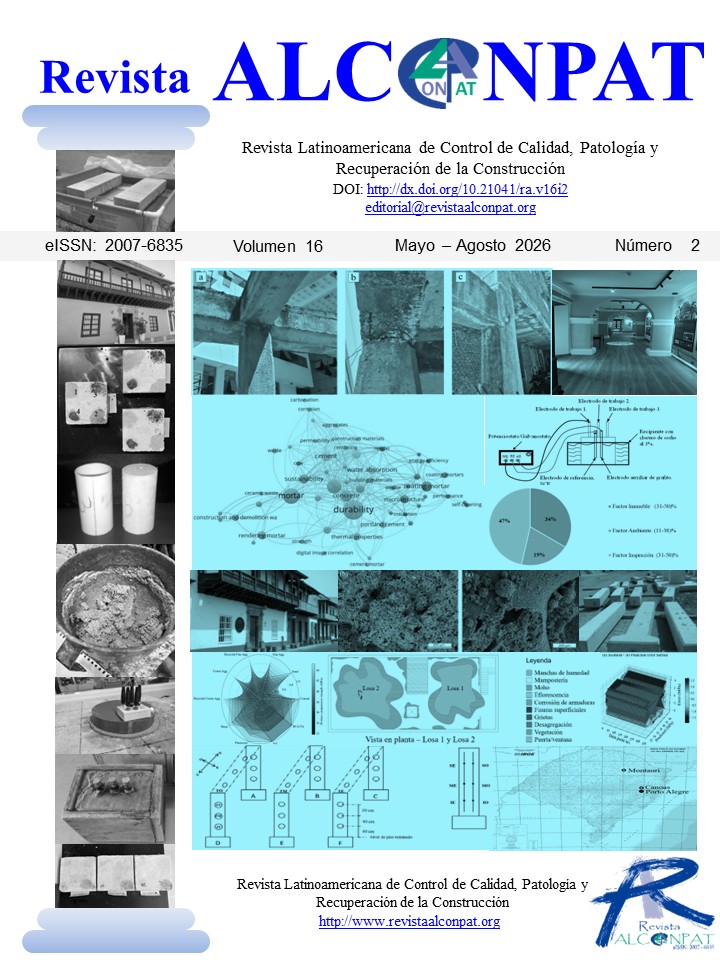
Structural assessment of an existing reinforced concrete building using a complementary approach based on visual inspection, non-destructive testing, and load testing.
DOI:
https://doi.org/10.21041/ra.v16i2.1013Keywords:
Visual inspection, Rebound hammer, UPV, Infrared thermography, Load testAbstract
This study aims to evaluate the structural suitability of an existing reinforced concrete building. The methodology is based on the integration of visual inspection, non-destructive testing (rebound hammer, ultrasonic pulse velocity, and infrared thermography), and load testing on slabs. The results reveal unfavorable conditions, with material heterogeneity, internal degradation, and non-uniform structural behavior. Limitations include the absence of destructive testing and detailed structural information. The main contribution of the study lies in the integration of assessment techniques at different levels of the structural system. The structure cannot be considered fully suitable for use in its current condition.
Downloads
References
Abdollahi-Mamoudan, F., Ibarra-Castanedo, C. and Maldague, X. P. (2025), Non-destructive testing and evaluation of hybrid and advanced structures: A comprehensive review of methods, applications, and emerging trends. Sensors. 25(12):3635. https://doi.org/10.3390/s25123635 DOI: https://doi.org/10.3390/s25123635
Abedin, M., Basalo, F. J. D. C., Kiani, N., Mehrabi, A. B. and Nanni, A. (2022), Bridge load testing and damage evaluation using model updating method. Engineering Structures. 252:113648. https://doi.org/10.1016/j.engstruct.2021.113648 DOI: https://doi.org/10.1016/j.engstruct.2021.113648
Ali-Benyahia, K., Kenai, S., Ghrici, M., Sbartaï, Z. M. and Elachachi, S. M. (2023), Analysis of the accuracy of in-situ concrete characteristic compressive strength assessment in real structures using destructive and non-destructive testing methods. Construction and Building Materials. 366:130161. https://doi.org/10.1016/j.conbuildmat.2022.130161 DOI: https://doi.org/10.1016/j.conbuildmat.2022.130161
Alqurashi, I., Alver, N., Bagci, U. and Catbas, F. N. (2025), A review of ultrasonic testing and evaluation methods with applications in civil NDT/E. Journal of Nondestructive Evaluation. 44(2):53. https://doi.org/10.1007/s10921-025-01190-0 DOI: https://doi.org/10.1007/s10921-025-01190-0
American Concrete Institute. (2025), ACI CODE-318-25: Building Code for Structural Concrete — Code Requirements and Commentary. American Concrete Institute.
Aquino Rocha, J. H., Murillo Borda, W., Herrera Rosas, M. and Cayo Chileno, N. G. (2025), Comparative Evaluation of Grids for the Detection of Internal Defects in Concrete Using Ultrasonic Pulse Velocity: Experimental Approach. Journal of Structural Design and Construction Practice. 30(4):04025074. https://doi.org/10.1061/JSDCCC.SCENG-1791 DOI: https://doi.org/10.1061/JSDCCC.SCENG-1791
Aquino-Rocha, J. H., Póvoas, Y. V. and Bezerra-Batista, P. I. (2024), Flaw recognition in reinforced concrete bridges using infrared thermography: A case study. Revista Facultad de Ingeniería Universidad de Antioquia. (110):99-109. https://doi.org/10.17533/udea.redin.20230521 DOI: https://doi.org/10.17533/udea.redin.20230521
ASTM International. (2016), ASTM C597/C597M-16: Standard test method for pulse velocity through concrete. ASTM International. https://doi.org/10.1520/C0597_C0597M-16
ASTM International. (2018), ASTM C805/C805M-18: Standard test method for rebound number of hardened concrete. ASTM International. https://doi.org/10.1520/C0805_C0805M-18 DOI: https://doi.org/10.1520/C0805_C0805M-18
Avdelidis, N. P. and Moropoulou, A. (2004), Applications of infrared thermography for the investigation of historic structures. Journal of Cultural Heritage. 5(1):119-127. https://doi.org/10.1016/j.culher.2003.07.002 DOI: https://doi.org/10.1016/j.culher.2003.07.002
Boccacci, G., Frasca, F., Bertolin, C. and Siani, A. M. (2024), Diagnosis of historic reinforced concrete buildings: a literature review of non-destructive testing (NDT) techniques. Procedia Structural Integrity. 55:160-167. https://doi.org/10.1016/j.prostr.2024.02.021 DOI: https://doi.org/10.1016/j.prostr.2024.02.021
Bortolini, R. and Forcada, N. (2018), Building inspection system for evaluating the technical performance of existing buildings. Journal of Performance of Constructed Facilities. 32(5):04018073. https://doi.org/10.1061/(ASCE)CF.1943-5509.0001220 DOI: https://doi.org/10.1061/(ASCE)CF.1943-5509.0001220
Breysse, D. (2012), Nondestructive evaluation of concrete strength: An historical review and a new perspective by combining NDT methods. Construction and Building Materials. 33:139-163. https://doi.org/10.1016/j.conbuildmat.2011.12.103 DOI: https://doi.org/10.1016/j.conbuildmat.2011.12.103
Bungey, J. H. and Grantham, M. G. (2006), Testing of concrete in structures. CRC Press. DOI: https://doi.org/10.1201/9781482264685
Cánovas, M. F. (1988), Patología y terapéutica del hormigón armado. Ed. Dossat.
De Domenico, D., Messina, D. and Recupero, A. (2022), Quality control and safety assessment of prestressed concrete bridge decks through combined field tests and numerical simulation. Structures. 39:1135-1157. https://doi.org/10.1016/j.istruc.2022.03.086 DOI: https://doi.org/10.1016/j.istruc.2022.03.086
Diaferio, M. and Varona, F. B. (2024), Concrete structures: latest advances and prospects for a sustainable future. Applied Sciences. 14(9):3803. https://doi.org/10.3390/app14093803 DOI: https://doi.org/10.3390/app14093803
European Committee for Standardization. (2021), EN 206:2013+A2: Concrete — Specification, performance, production and conformity. CEN.
Fédération internationale du béton. (2020), fib Bulletin 90: Visual inspection of concrete structures. fib.
Fuhaid, A. F. A. and Niaz, A. (2022), Carbonation and corrosion problems in reinforced concrete structures. Buildings. 12(5):586. https://doi.org/10.3390/buildings12050586 DOI: https://doi.org/10.3390/buildings12050586
Ghosn, M., Frangopol, D. M., McAllister, T. P., Shah, M., Diniz, S. M. C., Ellingwood, B. R. and Zhao, X. L. (2016), Reliability-based performance indicators for structural members. Journal of Structural Engineering. 142(9):F4016002. https://doi.org/10.1061/(ASCE)ST.1943-541X.0001546 DOI: https://doi.org/10.1061/(ASCE)ST.1943-541X.0001546
Gupta, M., Khan, M. A., Butola, R. and Singari, R. M. (2022), Advances in applications of non-destructive testing (NDT): A review. Advances in Materials and Processing Technologies. 8(2):2286-2307. https://doi.org/10.1080/2374068X.2021.1909332 DOI: https://doi.org/10.1080/2374068X.2021.1909332
Harris, S. Y. (2001), Building pathology: deterioration, diagnostics, and intervention. John Wiley & Sons.
Ibrahim, A., Faris, N., Zayed, T., Qureshi, A. H., Abdelkhalek, S. and Abdelkader, E. M. (2026), Application of infrared thermography in concrete bridge deck inspection: current practices, challenges and future needs. Nondestructive Testing and Evaluation. 41(1):1-44. https://doi.org/10.1080/10589759.2024.2443810 DOI: https://doi.org/10.1080/10589759.2024.2443810
Ichi, E. and Dorafshan, S. (2022), Effectiveness of infrared thermography for delamination detection in reinforced concrete bridge decks. Automation in Construction. 142:104523. https://doi.org/10.1016/j.autcon.2022.104523 DOI: https://doi.org/10.1016/j.autcon.2022.104523
Krentowski, J. R. (2021), Assessment of destructive impact of different factors on concrete structures durability. Materials. 15(1):225. https://doi.org/10.3390/ma15010225 DOI: https://doi.org/10.3390/ma15010225
Krentowski, J. R., Knyziak, P., Pawłowicz, J. A. and Gavardashvili, G. (2023), Historical masonry buildings’ condition assessment by non-destructive and destructive testing. Engineering Failure Analysis. 146:107122. https://doi.org/10.1016/j.engfailanal.2023.107122 DOI: https://doi.org/10.1016/j.engfailanal.2023.107122
Kumavat, H. R., Chandak, N. R. and Patil, I. T. (2021), Factors influencing the performance of rebound hammer used for non-destructive testing of concrete members: A review. Case Studies in Construction Materials. 14:e00491. https://doi.org/10.1016/j.cscm.2021.e00491 DOI: https://doi.org/10.1016/j.cscm.2021.e00491
Lin, L., Xie, M., Li, X., Zheng, K., Wang, J., Yu, K. and Bai, Y. (2025), Carbonation of cement-based materials under different conditions: From multi-characterizations to mechanism exploration. Construction and Building Materials. 491:142764. https://doi.org/10.1016/j.conbuildmat.2025.142764 DOI: https://doi.org/10.1016/j.conbuildmat.2025.142764
Malhotra, V. M. and Carino, N. J. (2003), Handbook on nondestructive testing of concrete. CRC Press. DOI: https://doi.org/10.1201/9781420040050
Ministerio de Transportes, Movilidad y Agenda Urbana. (2021), Código Estructural. Gobierno de España.
Nogueira Diniz, J. D. C., Paiva, A. C. D., Junior, G. B., de Almeida, J. D. S., Silva, A. C., Cunha, A. M. T. D. S. and Cunha, S. C. A. P. D. S. (2023), A method for detecting pathologies in concrete structures using deep neural networks. Applied Sciences. 13(9):5763. https://doi.org/10.3390/app13095763 DOI: https://doi.org/10.3390/app13095763
Olaszek, P., Łagoda, M. and Casas, J. R. (2014), Diagnostic load testing and assessment of existing bridges: examples of application. Structure and Infrastructure Engineering. 10(6):834-842. https://doi.org/10.1080/15732479.2013.772212 DOI: https://doi.org/10.1080/15732479.2013.772212
Othman, F. Z. and Ayop, S. S. (2021), Evaluation of corrosion in reinforced concrete: A review on the application of UPV method. Recent Trends in Civil Engineering and Built Environment. 2(1):160-170.
Poursaee, A. and Angst, U. M. (2023), Principles of corrosion of steel in concrete structures. In: Corrosion of steel in concrete structures. Woodhead Publishing. 17-34. https://doi.org/10.1016/B978-0-12-821840-2.00004-3 DOI: https://doi.org/10.1016/B978-0-12-821840-2.00004-3
Qian, R., Li, Q., Fu, C., Zhang, Y., Wang, Y., Jin, N. and Jin, X. (2023), Investigations on atmospheric carbonation corrosion of concrete structure beam exposed to real marine-environment for 7 years. Journal of Building Engineering. 71:106517.
https://doi.org/10.1016/j.jobe.2023.106517 DOI: https://doi.org/10.1016/j.jobe.2023.106517
Richardson, M. G. (2023), Fundamentals of durable reinforced concrete. CRC Press. DOI: https://doi.org/10.1201/9781003261414
Rocha, J. H. A., Chileno, N. G. C. and Toledo Filho, R. D. (2025), Mechanical and durability performance of mortars with Portland cement, recycled concrete powder, and metakaolin under accelerated carbonation conditions. Powder Technology. 453:120616. https://doi.org/10.1016/j.powtec.2025.120616 DOI: https://doi.org/10.1016/j.powtec.2025.120616
Rocha, J. H. A., Santos, C. F. D., Oliveira, J. B. D., Albuquerque, L. K. D. S. and Póvoas, Y. V. (2018), Detecção de infiltração em áreas internas de edificações com termografia infravermelha: estudo de caso. Ambiente Construído. 18(4):329-340. https://doi.org/10.1590/s1678-86212018000400308 DOI: https://doi.org/10.1590/s1678-86212018000400308
Rocha, J. H. A., Silva, M., Póvoas, Y. and Monteiro, E. (2017), Análise da profundidade de fissuras em concreto com termografia infravermelha. Revista de Engenharia e Pesquisa Aplicada. 2(3). https://doi.org/10.25286/repa.v2i3.688 DOI: https://doi.org/10.25286/repa.v2i3.688
Smith, M. and West, B. N. (2021), Building pathology. In: Building Surveyor’s Pocket Book. Routledge. 89-133. DOI: https://doi.org/10.1201/9781315142647-5
Watt, D. S. (2025), Building pathology: Principles and practice. John Wiley & Sons.
Published
How to Cite
Issue
Section
License
Copyright (c) 2026 Peredo Villarroel, J. G., Rojas Quispe, C. D., Lafuente Fernandez, J., Ticona Martinez, J., Callao Corrales, H. N., Solis, R., Aquino Rocha, J. H.

This work is licensed under a Creative Commons Attribution 4.0 International License.
_______________________________
License in effect from September 2020
You are free to:
- Share — copy and redistribute the material in any medium or format for any purpose, even commercially.
- Adapt — remix, transform, and build upon the material for any purpose, even commercially.
- The licensor cannot revoke these freedoms as long as you follow the license terms.
Under the following terms:
- Attribution — You must give appropriate credit , provide a link to the license, and indicate if changes were made . You may do so in any reasonable manner, but not in any way that suggests the licensor endorses you or your use.
- No additional restrictions — You may not apply legal terms or technological measures that legally restrict others from doing anything the license permits.
Notices:
You do not have to comply with the license for elements of the material in the public domain or where your use is permitted by an applicable exception or limitation .
No warranties are given. The license may not give you all of the permissions necessary for your intended use. For example, other rights such as publicity, privacy, or moral rights may limit how you use the material.



















.png)