
| Documental Research | https://doi.org/10.21041/ra.v15i2.814 |
Service life evaluation in concrete rehabilitation – a sustainability benefit
Evaluación de la vida útil en la rehabilitación de hormigón - un beneficio de sostenibilidad
Consideração da vida útil na reabilitação de concreto – um benefício à sustentabilidade
1 Vice President, GEI Consultants, Inc., P.C., 1000 New York Avenue, Suite B, Huntington Station, NY, USA.
*Contact author: pstivaros@geiconsultants.com
Received: 27/09/2024
Revised: 18/03/2025
Accepted: 28/04/2025
Published: 01/05/2025
| Cite as: Stivaros, P. C. (2025), “Service life evaluation in concrete rehabilitation – a sustainability benefit.”, Revista ALCONPAT, 15 (2), pp. 205 – 217, DOI: https://doi.org/10.21041/ra.v15i2.814 |
Abstract
This paper discusses several repair design and maintenance practices to produce durable and sustainable concrete structures. Emphasis is given in the assessment and evaluation of deteriorated concrete structures. The evaluation and repair principles are demonstrated through case studies of deteriorated concrete structures. Concrete preservation is an important consideration to sustain both economic and natural resources. Concrete, like almost any other building material, is susceptible to deterioration during its service life. Repairing and extending the service life of concrete structures contributes to overall sustainability of materials and resources. Assessment and repair decisions should be based on a thorough evaluation consisting of visual inspection, nondestructive Testing (NDT), laboratory testing, and a service life evaluation analysis.
Keywords: concrete repair, concrete sustainability, structural assessment, nondestructive testing, service life.
1. INTRODUCTION
Sustainability is a broad concept that encompasses several goals, such as economic development, social development, and environmental development. In simple terms, sustainability is the development that meets the needs of the present without compromising the ability of future generations to meet their own needs. The construction industry worldwide consumes a large amount of natural resources, as well as contributing to adverse environmental effects. Thus, the need to develop sustainable construction practices is important. Concrete is by far the most widely used construction material. Concrete has elevated itself to the top of construction material because of its advantages over other building materials. Concrete is easily and readily formed into various shapes and sizes, and it is adaptable to any application, geographical locations, and climates. Concrete, if designed, built and maintained properly it can last forever, and this is no exaggeration! Thus, concrete can be and should be a sustainable building material.
A sustainable concrete structure should be designed, constructed and maintained in such a way that the total environmental impact during its life cycle is minimized. Portland cement is the principal ingredient in concrete. Cement manufacturing is an energy intensive process which includes grinding and heating a mixture of raw materials such as limestone, clay, sand, and iron ore in a rotary kiln. This process produces toxic emissions and releases significant amounts of carbon dioxide (CO2) in the environment.
The environmental greenhouse issues associated with the production of cement and the consumption of natural resources dictate the development of means and procedures to improve the manufacturing energy and environmental efficiency of cement. Additionally, the use of cement should be minimized and/or partially substituted with other cementitious materials that their production requires less energy and emits fewer toxic gasses. Minimizing cement usage can be achieved by proper and efficient structural design and proper maintenance after construction. It is very important to develop effective protection methods for concrete structures to extend their service life and eliminate the need to repair or rebuild. For existing deteriorated concrete structures, the extension of their service life is achieved through a thorough understanding of the type, cause and extent of damage and the implementation of appropriate repairs and maintenance.
Development of sustainable plans in the construction industry starts with the inception of the project and extends to construction and beyond its service life. This paper discusses several design, construction, and maintenance considerations to produce durable concrete structures. Emphasis is given in the evaluation and repair of deteriorated concrete structures using service life evaluation models.
2. CONNECTION BETWEEN SERVICE LIFE EVALUATION AND SUSTAINABILITY
The main thrust of sustainability development plans includes the conservation of resources and reduction of waste. Therefore, the longer the structures are in service, the lower the environmental impact is over their service life. Structures are subjected to damage and deterioration primarily due to usage and environmental effects. Traditional approaches often involve complete replacement, which is resource- intensive and environmentally harmful. Service life evaluation provides a more sustainable approach by assessing the remaining life of existing concrete structures and identifying appropriate rehabilitation techniques. Repairing and therefore, extending the service life of concrete structures contributes to overall sustainability of materials and resources. The structural assessment, service life evaluation and rehabilitation of deteriorated concrete structures are necessary for extending their service life, maintaining structural integrity but also for promoting sustainable practices in construction and infrastructure management.
In summary, the service live evaluation is an essential tool in the structural assessment of distressed concrete structures that can lead to appropriate and long-term durable repairs and thus maximizing the service life of structures and minimizing their environmental impact.
3. SUSTAINABILITY IN CONCRETE DESIGN
The structural concrete design is usually governed by building codes and local rules and regulations. Building codes of the past emphasize the strength and safety of the structures with little durability requirements. The concrete industry reacted positively in developing design and construction standards incorporating protection and durability requirements in-line with sustainable development plans. The American Concrete Institute (ACI) has initiated a sustainability campaign and implemented many improvements in sustainable development throughout the ACI’s design, construction and materials publications, including the document ACI 130R-19 Report on the Role of Materials in Sustainable Concrete Construction (ACI 130R, 2019). The American Institute of Architects (AIA) has developed a guide for owners and engineers/architects on how to develop agreements for projects with sustainable objectives (AIA Document D 503, 2013).
Structural engineers can significantly influence the environmental impacts of concrete structures through design decisions and project specifications. The following are several factors that affect the sustainability performance of concrete structures:
Design Loads: Having a structure that can resist disasters without suffering significant damage is considered more sustainable.
Structural Efficiency: Optimize performance and minimize waste. Do not oversize members.
Durability: A combination of good design detailing, and protection, along with durable concrete mix design can result in a durable, and therefore sustainable, concrete structure.
Constructability: Smaller member sizes with congested reinforcement and nonstandard sizes require more energy and effort. Also, prescriptive specifications could render the project unsustainable.
Energy Efficiency: Concrete buildings are typically more energy efficient.
Concrete Mixes: The proportions of ingredients used for concrete mixtures can have a significant influence on the environmental footprint of concrete. Performance specifications would allow for mixture optimization, improve product quality, stimulate innovation, reduce construction cost and minimize construction time, while reducing environmental footprint. A sustainable concrete mixture should include:
Minimize energy and CO2 footprint. Use alternate cementitious materials. Minimize potable water Use. Use water reducing admixtures. Minimize waste Increase use of recycled content
Sustainability and durability go hand-in-hand. Experience has shown us that concrete buildings do not fall down as fast as they are falling apart because of damage and deterioration. Durability is related to the ability of the structures to resist weathering action, chemical attack, abrasion, and other potential deteriorating conditions during service. Designing for durability is undeniably the best economic and social investment because it reduces the maintenance and repair cost and extends the service life of the structure. Durability design practices may include proper concrete mix designs, sufficient cover over steel reinforcement, proper curing and protection at early age, and installing protective treatments. The most effective sustainability development plan is to avoid the need for extensive maintenance and repairs. ICRI Committee 160 Life Cycle and Sustainability (2015), developed a White Paper on sustainability for repairing and maintaining concrete and masonry buildings. The ICRI (2015) paper makes the case that proactive protection, maintenance, and repairs offer the ultimate inherent sustainable advantages in terms of cost, longevity, energy, and even cultural responsibility.
Generally, a sustainable structural design should include both strength and durability requirements, as well as other sustainability considerations such as structural efficiency, constructability considerations, energy efficiency, and most importantly the concrete mix design with minimizing the use of cement and water.
4. STRUCTURAL ASSESSMENT
Structures are subjected to damage and deterioration primarily due to usage and environmental effects. Periodic inspections and repairs can prevent lengthy and costly repairs. A damaged concrete structure requires a structural assessment and evaluation to determine the cause and extent of the damage. To design a durable, and therefore a sustainable repair, it is required to have a thorough understanding of the deterioration mechanisms, the rate of deterioration and the potential effects of existing deteriorated conditions. It is important to know if the damage is due to stress related effects, or environmental effects such as water infiltration and freeze-thaw action. Equally important is to verify the physical properties and durability characteristics of the damaged concrete. Certain questions need to be addressed before repair and rehabilitation. Is the concrete to be salvaged in good condition? What is its in-situ compressive strength? Is it carbonated with a potential of steel corrosion? Does it include any chemical contaminants? Has it undergone a chemical attack with potential future damage? Does it include internal microcracking?
The assessment and evaluation process includes the development of an investigation program, including condition surveys, nondestructive testing, material laboratory testing, and structural design verification. The assessment should include information on the type, cause and extent of damage, and required future maintenance and monitoring. An important element of the investigation program is the evaluation of repair alternatives through a service life evaluation. Improper assessment can lead to inappropriate repair details and material specifications, which will result to premature failure of the repair and accelerate damage to other non-damaged portions of a structure. Thus, the level of sustainability is decreased.
ACI 364 (2019) provides general procedures for the evaluation of concrete structures before rehabilitation and repair. ACI 562 (2019) codifies the minimum requirements for assessment, repair, and rehabilitation of existing structures. Other codes, industry standards, and guides are available providing information on how to tackle the complex issues of a repair program, such as:
ACI 201.1R (2008), Guide for Conducting Visual Inspection of Concrete in Service
ACI 224.1R (2007), Causes, Evaluation and Repair of Cracks in Concrete
ACI 228.2R (2013), Report on Nondestructive Test Methods for Evaluation of Concrete Structures
ACI 546R (2023), Guide to Concrete Repair
ACI 563 (2018), Specifications for Repair of Concrete in Buildings
ICRI No. 210.4 (2021), Guide for Nondestructive Evaluation Methods for Condition Assessment, Repair, and Performance Monitoring of Concrete Structures
ICRI No. 310.1R (2008), Guide for Surface Preparation for the Repair of Deteriorated Concrete Resulting from Reinforcing Steel Corrosion
In general, a proper structural assessment and evaluation will lead to appropriate structural repairs, as well as durable repairs that will extend the service life of concrete structures and thus, contributing to the overall sustainability of materials and resources.
5. SERVICE LIFE EVALUATION – GENERAL CONCEPT
Technical Service Life for a concrete member is the time in service until a defined unacceptable state is reached, such as spalling of concrete, safety level below acceptable, or failure of elements. This is an important element of the repair design is the service life and cost analysis of the repairs. A service life evaluation should be performed on concrete structures to determine the potential of future deterioration and evaluate alternate repair methods.
Deterioration of reinforced concrete structures is mostly due to the corrosion of the reinforcing steel embedded in the concrete. Steel corrosion is usually attributed to the ingress of chlorides and other corrosive chemicals within the concrete mass. In general, the service life evaluation of a concrete structure under repair is based on probabilistic models that predict the time required for contaminants to reach the embedded steel in concrete and initiate corrosion. The analysis considers the specific characteristics of concrete, existing damage, material properties, the local environmental conditions, and the protective treatments of the exposed concrete surfaces.
In summary, the sustainable benefit provided by the evaluation of service life lies in the fact that it must be done at the Prevention level from the project. This will imply substantial savings in the use of resources and materials and thus reducing the environmental impact of structures. If the evaluation is initiated from the need for repair, the benefit will be to consider this as the starting point for the prevention of the recurring problem and thus extending the life of the structure.
6. REPAIR DESIGN DEVELOPMENT
The required repair design and details should be developed based on the assessment and evaluation. The applicable codes and standards of the original building design and construction, as well as the repair design-basis code should be determined. Repair materials should be compatible with the structure, and within the service environment. Anticipated maintenance shall be considered in the selection of repair materials and methods. As per ACI 562 (2019), the repair design should address the strength (load carrying capacity of the damaged members), structural serviceability (such as overall stability, fire resistance, deflection, cracking and excessive vibration), and the long-term durability (ability of the structural elements to resist deterioration).
The restoration of member strength is usually mandated by the governing building codes. A structure should be restored to its originally designed load-carrying capacity. Some durability requirements, such as concrete cover, are also mandated by the codes. Other durability requirements, such as protective coatings, are usually not required by code. Though, protective measures have a significant impact on the useful service life of structures.
The effectiveness and longevity of a concrete repair depends very much on the surface preparation, repair material application, and protection and curing of the repair. Thus, a strict quality assurance program should be developed, and inspection procedures should be specified. The quality assurance program should include provisions for inspection and testing to verify the quality of workmanship and repair materials.
ICRI (2015) discusses several principles for sustainable and durable repairs of concrete structures:
Repair design: Salvage as much existing material as possible. Provide surface protection measures and provide adequate protection of steel bars to avoid corrosion.
Waste management: Minimize waste and/or recycle waste.
Use “green” repair materials: recycled, locally sourced, durable, service life considerations, easy to use.
Sustainable repair techniques: Consider the environmental impact of the method of concrete removals and include corrosion control measures.
Repair implementation: Establish a quality control program.
Monitoring: Initiate a monitoring program and implement preventive maintenance.
Generally, a sustainable repair design should include both strength and durability requirements, as well as other sustainability considerations such as salvaging and reusing materials, minimizing waste, using recycled materials, and considering the environmental impact of the demolition and discarding building materials.
7. CASE STUDY: STRUCTURAL EVALUATION AND REPAIR OF ENVIRONMENTAL STRUCTURES
The principles of assessing and evaluating concrete structures before rehabilitation are demonstrated by a case study involving the concrete tank repairs at a wastewater treatment plant. Unlike building structures, environmental structures are built to last, and, in fact, some municipalities require a service life of well over 100 to 200 years. Treatment plants, pipelines, and other environmental facilities must be properly designed, constructed, and maintained over their life cycles, to sustain the levels of service needed. Caring for these structures is the key to their sustainability and successful performance.
The assessment, evaluation, and repair of environmental structures present some distinct differences as compared to studies for building type structures. The severe exposure conditions, with continuous attack from the elements, the continuous presence of water and other liquids, the continuous attack from chemicals, and the surface erosion from liquid movement are some of the differences that separate environmental structures from other structures.
This case study investigates the cause and extent of deterioration and develops repair design for liquid containing concrete tanks at a wastewater treatment plant. The concrete settling tanks of the plant displayed extensive deterioration in the form of surface erosion, cracking, spalling, reinforcement corrosion, and other signs of distress and deterioration. The purpose of the structural investigation of the concrete tanks was to determine the general condition, the extent of damage, the type and cost of needed rehabilitation repairs, and the remaining useful service life of the concrete tanks.
The project objectives were as follows:
Identify type and extent of damage
Determine concrete quality and strength
Assess the effect of damage on the structural integrity
Identify and evaluate repair options
Review of available construction documents
Condition surveys - visual inspections
Destructive probing
Nondestructive testing
Laboratory testing of concrete samples
Service life evaluation
Structural assessment
Repair design
Repair construction
A successful repair program that restores structural integrity and maximizes the service life of distressed concrete structures depends on proper planning and execution of the structural assessment and repair design and construction. Such planning should include the establishment of the project objectives and expectations, as well as how to achieve such objectives.
7.1 Condition Surveys
The visual observations were performed in accordance with ACI 201.1R (2008). Observed conditions included: cracks, spalls, exposed aggregates and surface erosion, exposed reinforcement, reinforcement corrosion, and damaged expansion joints. Based on the visual observations, a detailed evaluation program was developed that included nondestructive testing and laboratory testing of concrete samples. Typical defects identified and repairs are illustrated in Figure 1.
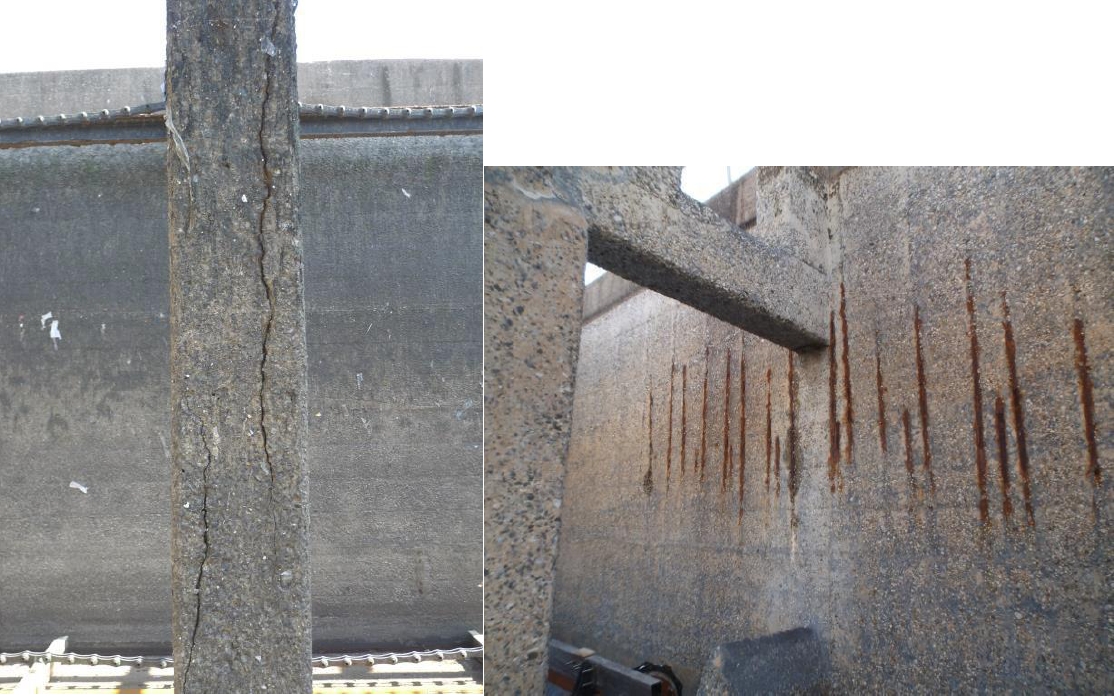
Figure 1. Cracked and spalled concrete columns and repairs. Exposed corroded reinforcing steel bars.
7.2 Nondestructive Testing
Visual observations provide information on readily visible damage only. Hidden damage within the concrete may be identified using nondestructive testing methods, as well as destructive probing. Nondestructive testing was performed at selected locations to confirm the soundness of the concrete, identify internal faults, identify potential reinforcement corrosion, and detect location and depth of reinforcement. Nondestructive testing methods included: steel cover testing, ground penetrating radar (GPR) testing, impact-echo, impulse response, and half-cell to measure the corrosion potentials. Description of nondestructive methods is provided in ACI 228.2R (2013). Photographs of nondestructive testing are illustrated in Figure 2. Summary of nondestructive testing includes:
Steel cover and GPR testing indicated that the steel reinforcement was located at depths ranging from exposed to as deep as 75 mm, with most of the bars being located at 35 mm to 50 mm from the surface. The design steel bar cover was 50 mm.
The impact-echo and impulse response testing indicated no significant structural deficiency of the tanks. The tank walls were solid without widespread structural faults and weaknesses. However, the testing indicated that there were scattered areas with localized defects such as shallow delaminations, honeycombing, and voids throughout the concrete tanks. These defects were mostly identified at the locations of exposed corroded steel bars, at crack locations and along the expansion joints.
The half-cell testing indicated a high probability of ongoing corrosion at the vicinity of the exposed corroded steel bars. The corrosion activity diminishes away from the exposed steel bars. No widespread corrosion activity was detected.
Probes at suspect areas showed that steel bars located at depths less than 12 mm exhibited slight to severe corrosion, while bars at larger depths exhibited slight to no corrosion.
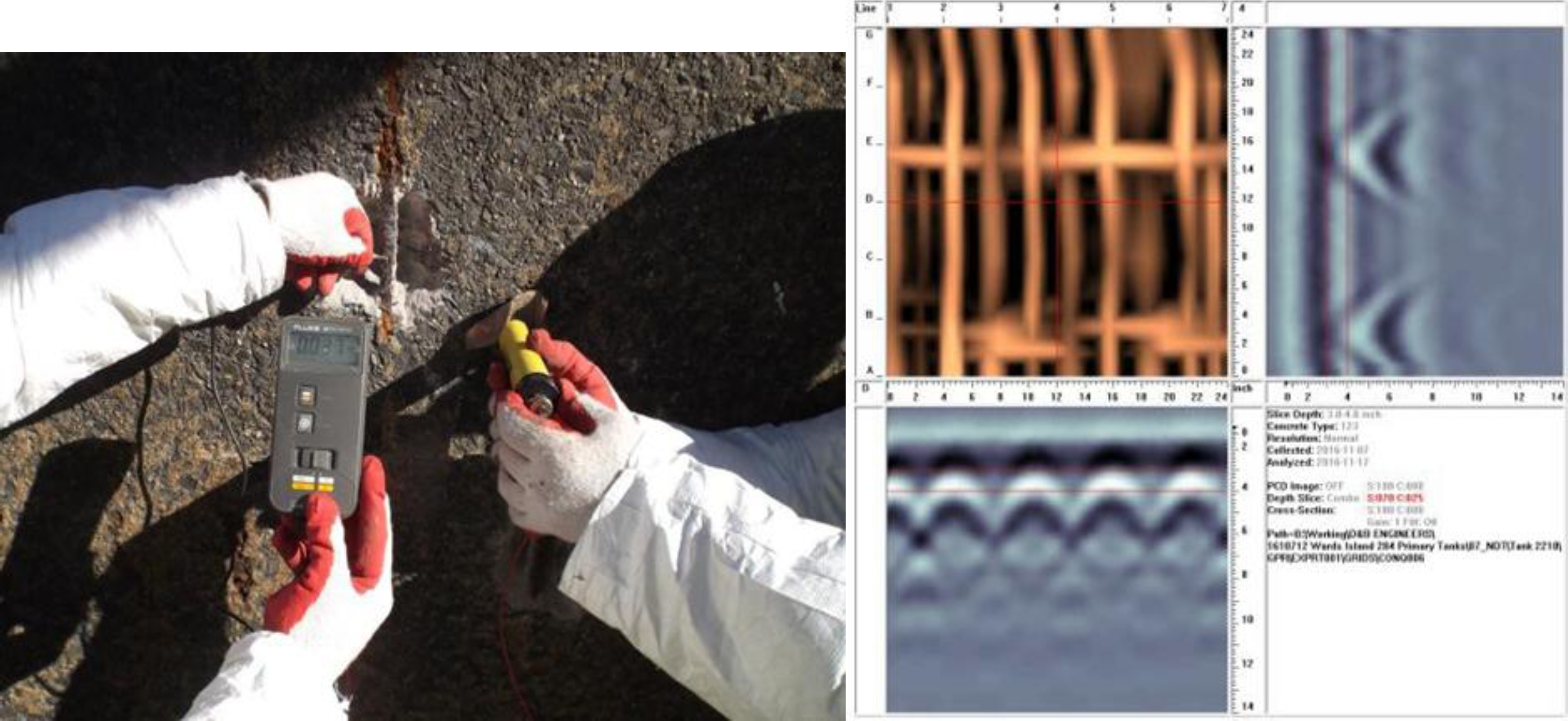
Figure 2. Half-Cell Testing: Measurement of corrosion potentials. GPR: Identify internal faults and rebar location.
7.3 Laboratory Testing
The purpose of the laboratory testing of concrete samples was to determine the strength and quality of the concrete, detect chemical attacks, and determine the long-term durability characteristics of the concrete. Laboratory testing included concrete compressive strength, chloride content, sulfate content, alkalinity (pH), and petrographic examination. Summary of laboratory testing includes:
The concrete core compressive strength ranged from approximately 30MPa to 70 MPa. The concrete design strength was 30 MPa.
The chloride content varied from 0.21 to 0.77 percent by weight of Portland cement at the exterior 25 mm and 0.12 to 0.44 at depths of 50 mm to 75 mm. The chloride levels are well above the ACI
ACI 318 (2019) suggested threshold limit of 0.15 percent (dry service) or 0.08 percent (wet service) above which corrosion of reinforcing steel may occur.
Sulfate content ranged from less than 0.0011% to 0.0016% by mass of concrete at the surface and below 0.001% at depths of 75 mm. These sulfate contents were well below the threshold limits suggested by ACI 318 (2019) for corrosion activity.
The depth of carbonation varied, with a maximum depth of 12 mm from the concrete surface.
The alkalinity levels (pH) of the concrete ranged between 10 and 12 from the surface to 75 mm depth. The measured pH values do not fall below the critical level of 8.5 at which the steel corrosion passivation protection film is disturbed, and corrosion may be initiated.
Petrographic examination indicated the following:
Good quality concrete with dense well graded aggregate well consolidation concrete. The exposed concrete surface was in poor condition. The concrete surfaces exhibited exposed sand grains, and extensive exposed aggregates exhibiting both paste loss and erosion. The long-term moisture exposure and water flow, as well as chemical attack from the water pollutants were determined to be the cause. There was no evidence of alkali-silica or other deleterious reactions between the cement paste and aggregate. Micro-cracking was observed mostly within the top 50 mm. The concrete was non-air entrained making it vulnerable to freeze-thaw action. Since the tanks are always filled with water, there was no freeze-thaw damage observed on the cores.
8. SERVICE LIFE EVALUATION
A service life evaluation of each type of liquid containing tanks or other suspect concrete elements through the entire plant was performed. Concrete cores were extracted from each type of structure, as well as wastewater samples will be collected, for laboratory testing. The concrete cores were tested to determine the ionic and moisture transport properties of the concrete. The wastewater sample were tested for pH, and various metal concentrations. The data collected from the concrete and water testing were used in the service life evaluation of concrete. Various simulations were performed to estimate the time to initiate corrosion of the steel reinforcement. The simulations included the state of the concrete deterioration and the various repair methods.
Two repair alternates were considered in the simulations:
a. Perform the minimum required repairs, including repair of cracks, spalls, expansion joints, and corroded rebars.
b. Perform the minimum required repairs as in Item (a), apply a 12 mm thick cementitious silica fume mortar, and apply a protective epoxy coating on all tank surfaces.
Results of the simulations are shown in Figures 3 and 4. The simulation results indicated that the chloride contaminants could reach at 50 mm depth and cause the reinforcing steel to corrode in approximately seven to ten years. Steel bars located close to the surface in less than 50 mm will start corroding in much less time. For bars located in more than 75 mm depth, the chlorides will require 20 to 40 years before they affect the steel bars. When a protective mortar layer and epoxy coating was introduced into the simulation, the time for corrosion initiation of rebars increased to well beyond 40 years.
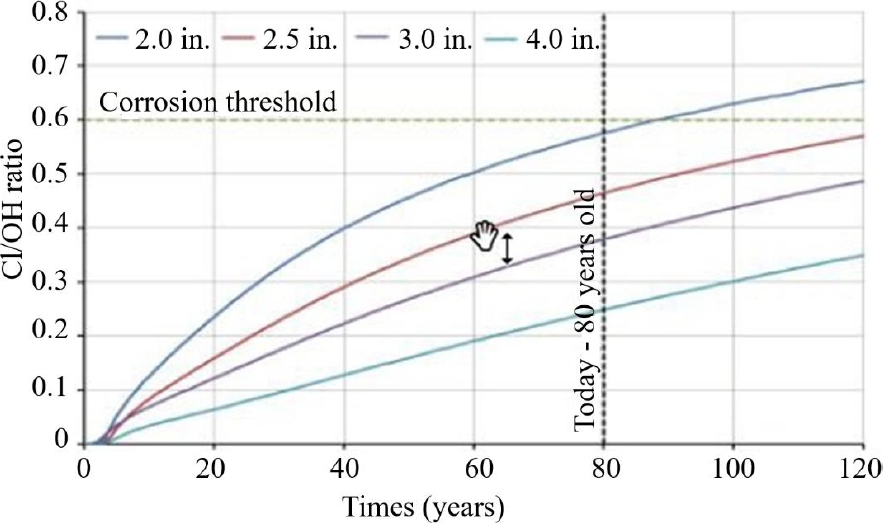
Figure 3. Evolution of Chloride/Hydroxide ratio over time and expected corrosion initiation of steel at different depts with minimal repairs to preserve concrete as it is.
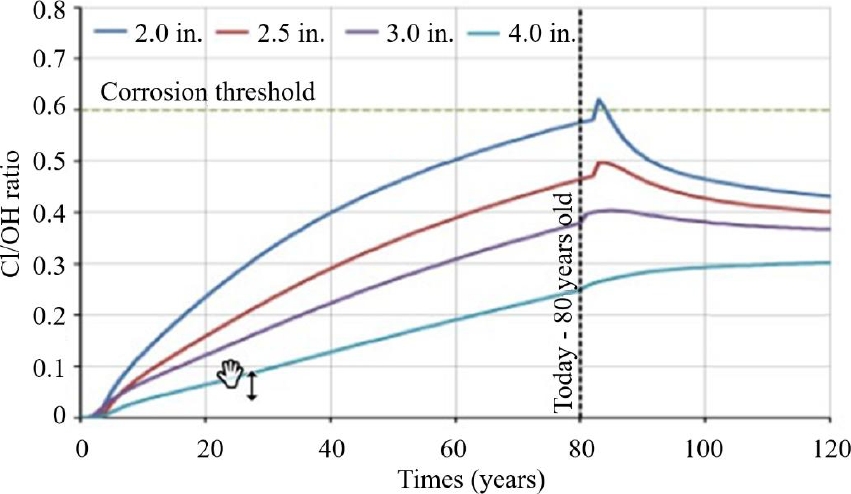
Figure 4. Evolution of Chloride/Hydroxide ratio over time and expected corrosion initiation of steel at different depts using robust repair strategy.
In summary, the results of service life simulations indicate that if the concrete is just patched and cracks filled, the corrosion initiation of the reinforcement will likely begin within few years. The simulation suggests that a repair which removes the damaged concrete, replaces it with dense mortar, and seals with a protective coating will likely protect the reinforcement from corrosion well beyond another 40 years, thus increasing the service life of the structures and minimizing their environmental impact.
9. REPAIR DESIGN
The philosophy of the repair design for this project was two-fold: restoration of the structural integrity of the concrete tanks; and ensuring their future long-term durability after the repairs. The suggested repair design included durable state-of-the art repair methods and materials. Thus, the durability was increased, and the service life of the tanks was extended. Long term durability of repairs and materials is an important sustainability issue since it reduces the environmental impacts of frequent replacement and repairs with the associated waste, manufacturing and debris disposal.
The service life evaluation indicated that by using a protective coating on the concrete surface will extend the life of the structure by double as compared to the option to perform only the minimum required repairs.
The repair design also considered the minimization of repair materials. The repair design intent was to repair only local damaged areas without full replacements or applying a continuous extra layer of concrete on top of existing tank walls and floors.
The concrete design specifications included sustainability provisions with respect to the materials used and quality control. The specifications included materials compatible with the existing substrates and had requirements for quality assurance, including mock-ups and testing of the repairs. The specifications also allowed the use of supplementary cementitious materials, such as fly ash, slag cement and silica fume. Thus, reducing the environmental impact of CO2, as well as using cementitious materials that can improve the long-term durability of concrete. Fly ash usually replaces up to 25% of cement, slag cement replaces up to 60% or more, and silica fume up to 8%.
Suggestions were also included for handling the waste. Removed damaged concrete could be recycled to produce new concrete that could be used for the other cast-in-place concrete needs of the plant, such as pavements, foundation base for sidewalks, or as a filling material.
Generally, a sustainable repair design for environmental structures should include both the restoration of the structural integrity and maximizing the long-term durability and service life of the repairs. For this case study, this was achieved with the proper assessment and service life evaluation, the development of appropriate repair details that used high quality repair materials and minimization of repairs and materials, and most importantly by applying a quality control program to make sure that the repair program is executed efficiently and properly.
10. CONCLUDING REMARKS
This study presented a discussion on the sustainability issues relating to concrete construction, and to concrete repairs with emphasis in the evaluation and repair of deteriorated concrete structures using service life evaluation models.
The service life of a concrete structure that is properly designed, constructed, and maintained can be extended with periodic inspections and repairs over its life. Concrete that lasts is concrete that is sustainable. Service life evaluation helps quantify the benefits of rehabilitation over replacement, emphasizing sustainability.
Concrete design that considers durability requirements in the protection and material is the best economic and social investment; the maintenance and repair cost is reduced, as well as the service life is extended. The most effective sustainability development plan is to avoid the need for extensive maintenance and repairs. The goal is to decrease the long-term impact of structures by creating durable structures.
The assessment and evaluation of damaged concrete structures before rehabilitation is of paramount importance. A proper structural assessment and service life evaluation is a prerequisite for a long-term durability of concrete and its structural integrity, and therefore its sustainability. The service life simulations should include the state of the concrete deterioration and the various repair methods.
Satisfactory and lasting repair work requires a thorough understanding of the cause and the extent of deterioration, as well as the physical and chemical properties of the existing concrete material; thus, proper surface preparation is performed, and compatible repair materials are applied.
11. REFERENCES
ACI Committee 130 (2019), “Report on the Role of Materials in Sustainable Concrete Construction (ACI 130R-19),” American Concrete Institute, Farmington Hills, Michigan, 34 pp.
AIA Document D503 (2013), “Guide for Sustainable Projects,”, American Institute of Architects, Washington, DC, 20120, 67 pp.
ICRI Committee 160 (2015), Life Cycle and Sustainability, Sustainability for Repairing and Maintaining Concrete and Masonry Buildings, 13 pp.
ACI Committee 364 (2020), “Guide for Evaluation of Concrete Structures before Rehabilitation (ACI 364.1R-20),” American Concrete Institute, Farmington Hills, Michigan, 24 pp.
ACI Committee 562 (2019), “Code Requirements for Evaluation, Repair, and Rehabilitation of Existing Concrete Structures and Commentary (ACI 562-19),” American Concrete Institute, Farmington Hills, Michigan,94 pp.
ACI Committee 201 (2008), “Guide for Conducting Visual Inspection of Concrete in Service (ACI 201.1R- 08),” American Concrete Institute, Farmington Hills, Michigan, 15 pp.
ACI Committee 224 (2007), “Causes, Evaluation and Repair of Cracks in Concrete (ACI 224.1R-07),” American Concrete Institute, Farmington Hills, Michigan, 22 pp.
ACI Committee 228 (2013), “Report on Nondestructive Test Methods for Evaluation of Concrete Structures (ACI 228.2R-13),” American Concrete Institute, Farmington Hills, Michigan, 82 pp.
ACI Committee 546R (2023), “Guide to Concrete Repair (ACI 546R-23),” American Concrete Institute, Farmington Hills, Michigan, 59 pp.
ACI Committee 563 (2019), “Specifications for Repair of Concrete in Buildings (ACI 563-18)” American Concrete Institute, Farmington Hills, Michigan, 40 pp.
ICRI No. 210.4 (2021) Guide for Nondestructive Evaluation Methods for Condition Assessment, Repair, and Performance Monitoring of Concrete Structures, 28 pp.
ICRI No. 310.1R (2008) Guide for Surface Preparation for the Repair of Deteriorated Concrete Resulting from Reinforcing Steel Corrosion, 8 pp.
ACI Committee 318 (2019) “Building Code Requirements for Structural Concrete and Commentary (ACI 318-19),” American Concrete Institute, Farmington Hills, Michigan, 623 pp.