
| Applied Research | https://doi.org/10.21041/ra.v15i3.807 |
How long to life? The survival of people in fire of a residential bedroom using Fire Dynamics Simulator – FDS
¿Cuánto tiempo vivir? La supervivencia de las personas en incendios de dormitorios residenciales, con el uso de FDS
Quanto tempo de vida? A sobrevida de pessoas em incêndios em dormitório residencial, com o uso do Fire Dynamics Simulator- FDS
C. Corrêa12* , W. Martins12, A. Castro2, M. Lopes2, B. Ferrrari Junior3
1 Universidade Federal de Pernambuco – Pós-Graduação de Engenharia de Incêndio, Recife, Brasil.
2 Corpo de Bombeiros Militar de Pernambuco - CBMPE, Recife, Brasil.
3 Corpo de Bombeiros Militar do Espírito Santo - CBMES, Vitória, Brasi
*Contact author: cristianocorreacbmpe@gmail.com.br
Received: 15/04/2025
Revised: 07/07/2025
Accepted: 13/08/2025
Published: 01/09/2025
| Cite as: Corrêa, C., Martins, W., Castro, A., Lopes, M., Ferrrari Junior, B. (2025), "How long to life? The survival of people in fire of a residential bedroom using Fire Dynamics Simulator – FDS", Revista ALCONPAT, 15 (3), pp. 384 – 412, DOI: https://doi.org/10.21041/ra.v15i3.807 |
Abstract
The paper provides a prognosis of the survival conditions of victims of a fire in a dormitory in a residential building, using the Fire Dynamics Simulator-FDS computer program. Based on a contextualization of deaths caused by fire in the world and in Brazil, most deaths occur in residential environments. Given the preventive gap in these environments, lethal concentrations of carbon monoxide and dioxide were analyzed, as well as the temperature and minimum oxygen concentration. The maximum time that occupants of the dormitory would remain in the four positions was estimated, considering people with mobility difficulties. It was found that the environment becomes lethal in a maximum of 8 minutes after the fire, in the positions studied.
Keywords: dormitory fire; residential fire; fire investigation; fire survival.
1. INTRODUCTION
Despite their frequency, building fires in Brazil are still not fully understood (Rodrigues et al., 2017). The buildings most susceptible to these incidents, their occupancy, resilience, and especially their ability to survive inside them, constitute information that has not yet been consolidated in the country (Hahnemann et al., 2017).
However, recent studies on urban fires in some regions of Brazil indicate a greater prevalence in residential buildings (Corrêa et al., 2015; Falcão, 2024).
It is also noteworthy, amid research conducted in the country, that in certain regions, the overwhelming majority of deaths and serious injuries result from fires in residences: both multi-family and, primarily, single-family (Santos, Corrêa, and Krüger, 2024; Menezes and Corrêa, 2022; Carnieletto, Castro, and Araújo, 2019; Santos, 2016), highlighting the importance of studying this type of fire with accurate lens.
Regarding survival and the ability to withstand extreme situations in environments where high temperatures and gases are released, it is crucial to define these as objects of study and thus develop methods that simulate such extreme conditions.
It is true that many studies use structural components subjected to high temperatures through the use of special furnaces and radiant panels in an attempt to decipher the behavior of these structures in fire situations (Costa, Pires, Rêgo Silva, 2023; Vasconcelos, Pires, Rêgo Silva, 2024; Laim et al., 2014), constituting highly relevant research in construction engineering. However, the interaction and dynamics of the fire load components (burning objects), the behavior of heat waves, and the flow and effects of flammable gases pose greater difficulties in accurately simulating them in furnaces or laboratories, sometimes requiring the construction of specific experiments.
Full-scale natural fire experiments are still rare in Brazil (Corrêa et al., 2017; Braga et al., 2021) and in Latin America, given the considerable risks and high costs of simulations.
Some studies use buildings that have suffered fires, through testimonies and scenario analysis, to estimate the event (Pignatta and Silva et al, 2007; Silva Filho et al, 2011; Hahnemann et al, 2018; Braga, 2022). In these cases, monitoring the fire dynamics is prospective, generally also using computer simulation.
Results very close to reality can be achieved using simulation software, using 'computational fluid dynamics' (CFD), as they are more accurate than hand-made engineering calculations, which do not always translate common and unexpected situations in the process of interaction between the fire dynamics and the decision-making of the occupants of the damaged property, or explaining the lack of such decisions. In many situations, this software reproduce fires identically (McGrattran et al. 2019).
Therefore, studying the survival conditions of victims within burned-down homes is crucial to mitigate the hundreds of lives lost (Corrêa, 2024a) annually in such incidents in Brazil.
The data obtained in this research, coupled with the lack of official data on the article's central theme, directly linked to the variables involved, draws attention to new discussions and research related to the production of carbon monoxide (primarily carbon dioxide), low oxygen percentages, and temperature rises to lethal levels during urban fires, as these are the most harmful and lethal. The study also presents important data on which positions and proximity to flames and smoke would have the most harmful consequences for human life. It is noteworthy that the environment used in the simulation was a bedroom (the room with the highest incidence of initial residential fires in the Recife Metropolitan Region (RMR)) containing the standard furniture, structure, and dimensions of a building measured in more than 1,000 fires that occurred in the city of Recife over a three-year period (Corrêa, 2017). The central idea of the article is the search for a minimum, satisfactory response time for the protection and rescue actions of victims of structural fires.
2. BIBLIOGRAPHIC REVIEW
This topic discusses, through the recall of technical and scientific works, some of the conceptual foundations that guide the research, necessary for understanding the study and its results.
2.1 Computational Models and Fires
According to Kuligowski et al. (2010), the three basic groups of computational models applied to the study of fire victims vary according to the data input. These include:
- Behavioral models: These simulate combinations of decision-making and movement along routes to safety, as well as the presence of fire and smoke, and situations of fainting and death. Examples of these models include the following software programs: STEPS, BuildingEXODUS, Legion, and MassMotion;
- Movement models: These simulate flow and movement speed for a homogeneous population. These can be useful in demonstrating congestion and bottleneck areas in building spaces. Wayout is an example of such software.
- Partial behavioral models: These models simulate movement and behaviors predetermined by variables such as pre-evacuation time, individual characteristics, and positional changes among occupants. The following software falls into this category: EXIT89, Simulex, Pathfinder, and GridFlow.
2.2 Research with Computational Fluid Dynamics in Fires, in Brazil
Using software such as FDS, PyronSim, SmartFire, and others, it is possible to reproduce the dynamics of heated gases and smoke movement in compartmentalized environments at reduced costs.
In this context and using the roadmap outlined by Tabaczenski et al. (2017), some studies on fire scenario simulations in Brazil stand out, using computer software, specifically FDS, some of which will be presented below.
Alves, Campos, and Braga (2008), using FDS and SIMULEX, another computer software for gas fluid dynamics analysis, reproduced a commercial building and analyzed the influence of smoke on the evacuation of people through escape routes, which were designed within SCI standards. They thus demonstrated the importance of using computer applications in the design phase of escape routes, as well as in proposing design solutions and modifications to current standards governing the subject. Braga and Landim (2008) conducted a FDS simulation of a 2007 residential fire in the city of Brasília as part of a fire investigation, aiming to test hypotheses about possible fire origins. The study concluded that the building's environments may have reached temperatures of 1,000°C, characteristics that coincided with photographic records of the environment, and highlighted the importance of computational tools in fire investigation.
Rodrigues (2009) simulated vertical compartmentalization in various facade configurations, applying the current Brazilian standard on the subject, using a reduced model and FDS simulation. The author concluded that external compartmentalization acts as a deterrent to the spread of fire on the facade and that the use of computational simulation provides approximations that are quite consistent with reality, which is a powerful tool in the design and improvement of passive protection.
Ruschel (2011) simulated a fire in a shopping mall in Porto Alegre in 2007 using PyroSim and FDS. By collecting samples from the fire and subjecting them to tests, and calibrating the model, the author was able to vary the possible fire scenarios, including the addition of preventive devices such as automatic sprinklers. In this case, the simulation helped to understand the behavior of fire in the environment in different ways.
Fontenelle (2012) studied the spread of fire in industrial tanks, whether or not subjected to wind and equipped with deluge firefighting systems, in the FDS. Using a computer simulation of a hypothetical tank farm, the author studied the effects of a fire in one of the tanks, filled with ethanol, on the other tanks, spaced according to the regulations. The author concluded from her observations that the parameters established by the regulations do not prevent the spread of fire to neighboring tanks.
Carvalho (2013) simulated the effects of forced ventilation on a vehicle fire in a tunnel like the Rebouças Tunnel in Rio de Janeiro. Using FDS, the author evaluated temperature, gas concentration, and heat flux in the tunnel, concluding that the existence of a forced ventilation system is beneficial to users in terms of temperature and heat flux and unfavorable in terms of the presence of smoke.
Brunetto (2015) studied the dynamics of temperature, heat flux, and gas temperature in a higher education building using PyroSim and FDS computer simulations. This study demonstrated the influence of free ventilation through the facades on the spread of flames and, consequently, how this interferes with evacuation via emergency stairs. The simulation may provide a solution for implementing preventive systems. Mazzoni and Klein (2015) simulated a building fire in the city of Porto Alegre in a computer environment using Autocad 3D, PyroSim, and FDS, to analyze possible causes of the loss identified by the experts. With the study, the authors analyzed the results as consistent with the actual damage caused and found that passive protection prevented the spread of the flames, confirming data collected by the experts at the site.
Cunha (2016) studied horizontal compartmentalization configurations in a classroom in a building in the FDS and their impact on improving fire safety. The author observed that larger exhaust openings would increase the time for smoke to reach the entire space, improving survival times during evacuations from affected areas.
Carlos et al. (2016) studied smoke control in a building parameterized by European standards and the evacuation time of this building, using the calculation method proposed by Nelson and MacLennan (1995), to analyze people's escape conditions due to high temperatures, visibility, and gases from combustion products. The authors conclude by noting the importance of smoke control and the lack of information on smoke control design indexes in European standards.
Mariani and Carlos (2017) simulated a two-story restaurant-type building using FDS and Evac, and the effectiveness of applying parameters established in Brazilian and Portuguese standards regarding emergency exits. The authors used the Nelson and MacLennan (1995) method to determine evacuation time and verified the influence of temperature and smoke layer on this evacuation. The authors concluded that observing only the standard applied to evacuation, such as emergency exits and the number of passageways, does not prevent the occurrence of possible deaths.
Matos (2017) analyzed the mass flow rate between connected compartments of a residential building connected by various opening scenarios using FDS and compared the results with experimental and analytical values. The author concluded that the results obtained are well represented by the experimental data collected.
In addition to the work dissected by Tabaczenski and co-authors (2017), there is an important investigative study in which Cunha, Lugon and Bona (2018) used the FDS to evaluate a fire-explosion hypothesis in the city of Vila Velha - ES. The authors simulated the leak of Liquefied Petroleum Gas (Propane and Butane) in the disaster scenario, and through the mean time measured in the investigation, they verified the compatibility of the gas concentration and the use of the switch, which were the initial cause of the fateful event (Cunha, Lugon and Bona, 2018).
2.3 Fire Deaths
In Brazil, there are no statistics released by official safety agencies on how many people are injured or killed in the country because of fires (Corrêa, Duarte, Braga, 2018).
Among the available studies, some stand out, such as the one presented in 2015 by the Sprinkler Brazil Institute, based on cross-referencing information from the Unified Health System (SUS) and the National Secretariat of Public Safety (SENASP). This study revealed 1,051 deaths from direct contact with heat and gases, or because of them, during fires that occurred in Brazil between 2009 and 2011.
Another study published by Corrêa (2024b) showed that deaths in Brazil, directly caused by fires or their consequences, revealed an alarming number of more than two thousand seven hundred deaths in a three-year period (2017-2019).
According to the same study, distributing the 737,199 fires that occurred between 2017 and 2019, there is a daily mean of 682 fires, distributed among the 26 states of the Federation and the Federal District. Also based on this study, it is also found that in the ten most populous states (São Paulo, Minas Gerais, Rio de Janeiro, Paraná, Bahia, Rio Grande do Sul, Pará, Ceará, Santa Catarina, and Pernambuco), there were 2,165 deaths in fires during the period studied, with a daily mean of 1.97 deaths for the period studied (Corrêa, 2024b).
Regarding the specificities of fires that cause deaths and injuries in Brazil, some regional studies are worth highlighting:
Santos (2024), when studying fires with victims in Belo Horizonte, states:
[quote]A total of 1,371 fire incidents were identified in buildings, of which 62.14% (852) occurred in single-family or multi-family homes. Victims were killed or injured in 133 incidents, totaling 166 victims, 8 of which were fatal. In 53% of the incidents, the victims were male. Regarding age groups, it was observed that adults aged 20 to 60 years old corresponded to 72.89% (121) of the cases, while the older adults over 60 years old represented 24.09% (40) and children up to 10 years old only 0.6% (1). The distribution of records throughout the year showed that the months of April, July and September corresponded to 35.3% (47) of the incidents, while February, August and December were only 15.03% (20). During the week, there was a tendency for the number of fires to increase as the weekend (Saturday and Sunday) approaches, accounting for 40% of all fires. Critical times were identified throughout the day, such as 2:00 AM to 3:00 AM and 11:00 PM to 12:00 AM. A certain concentration of fires with victims was also observed between 9:00 PM and 6:00 AM, which accounted for 45.9% (61) of all fires.[/quote]Carnieletto, Castro, and Araújo (2019), when studying a decade of fires in Paraná, report that between 2005 and 2016, 2,168 occurrences were recorded, specifically in single-ground residential buildings. This raises an important alert regarding the deaths that occurred in this type of incident (fire in residential buildings):
[quote]When observing the percentages of deaths in buildings, as in figure 4, ground floor residential buildings fluctuate between 75% in 2015 and 100% in 2010, obtaining a mean of approximately 87%, which gives us a high percentage when observing only a separate group of occurrences. (Carnieletto, Castro e Araújo, p.98)[/quote]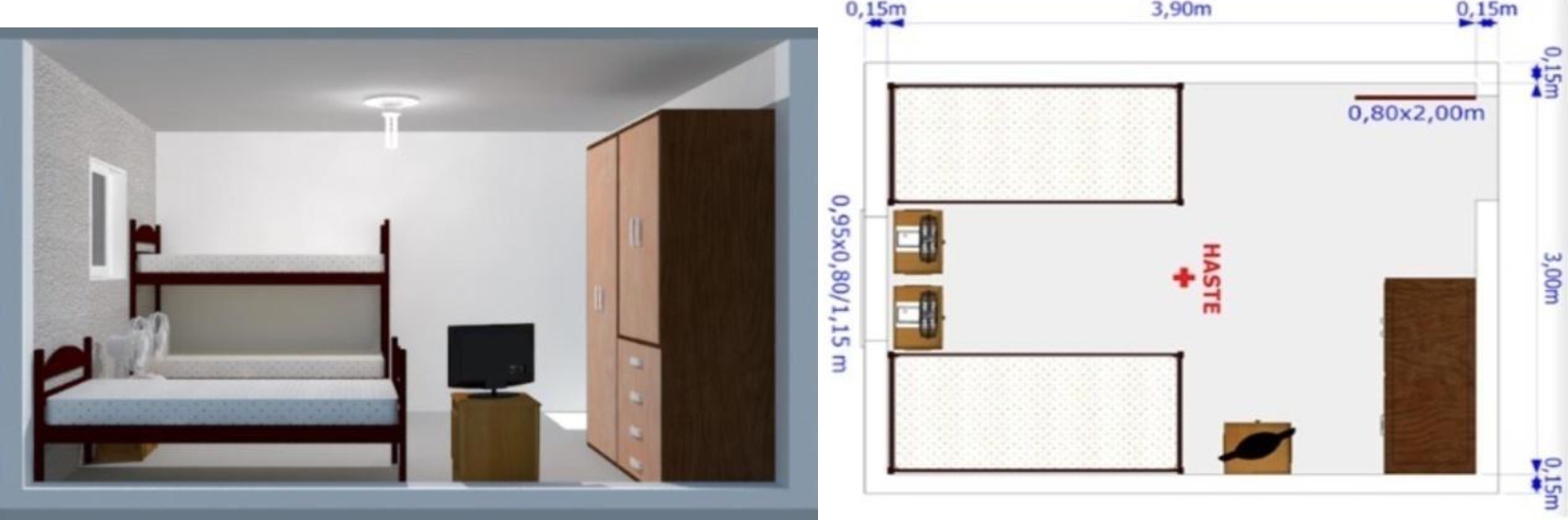
Figure 1. Illustrations of the tested environment and thermocouple distribution. Source: Adapted from Corrêa et al., 2017.
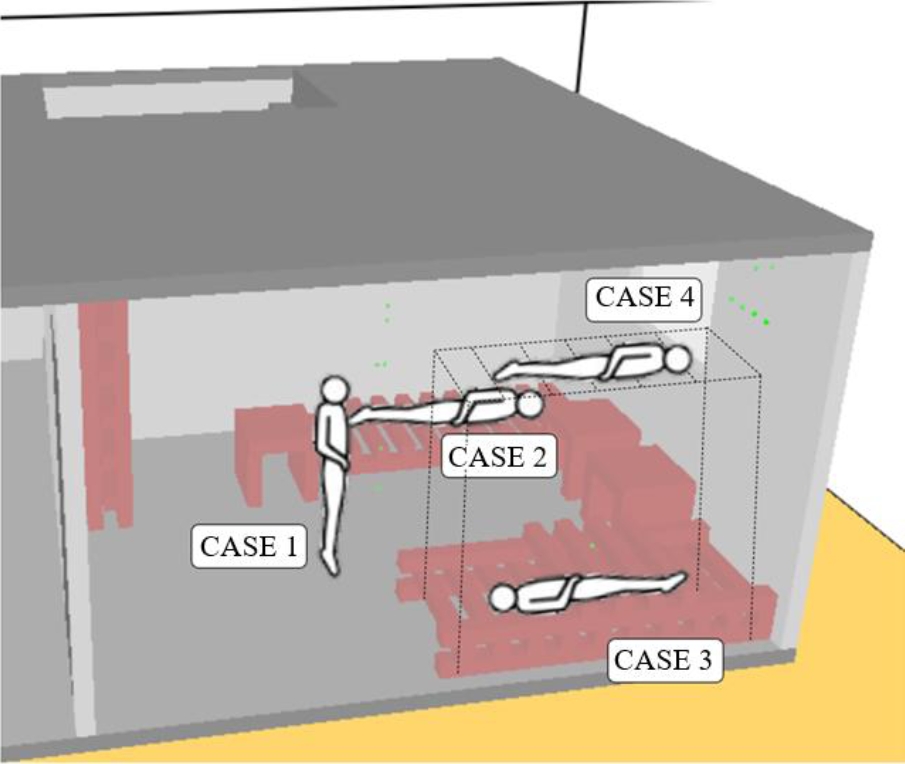
Figure 2. Illustrative diagram of victims in the fire scenario.
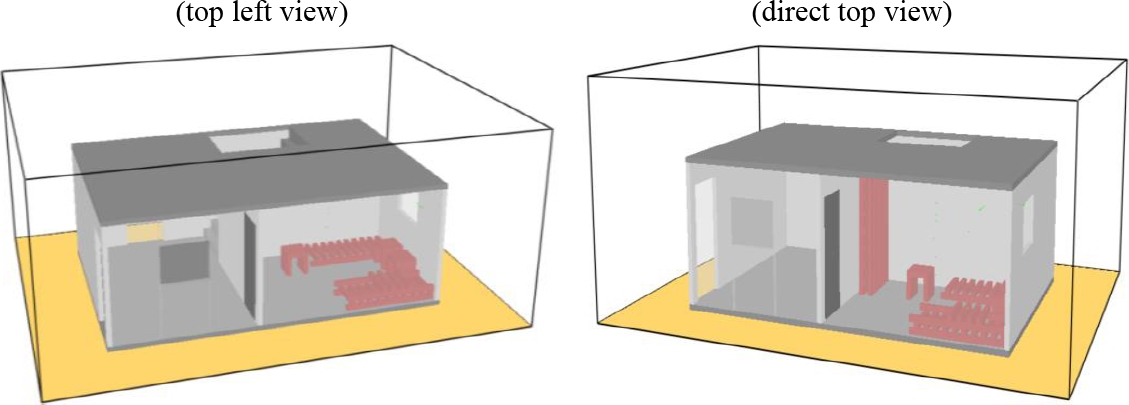
Figures 3 and 4. Scenario used for fire simulation Source: Research Data, 2025.
Santos (2016), when defending the use of fire detectors in residential buildings, states:
[quote]Although 7% of fires occur in single-family homes, they cause 80% of deaths. These buildings lack national standards or legislation regulating specific fire protection systems. (Santos, 2016, p.262).[/quote]These assertions are based on the 2012-14 triennium, focusing on the State of São Paulo (Santos, 2016).
Menezes and Corrêa (2022), when studying fires with victims in the Metropolitan Region of Recife, in the period 2013-16, point out:
[quote]Accounting for one-third of all fires recorded in the Metropolitan Region of Rio Grande do Norte, residential fires are notable for causing deaths and injuries. A contributing factor is the lack of preventive systems in single-family buildings, which, according to data collected in this study, accounted for 94% of fires resulting in deaths and 88% of those resulting in injuries. (Menezes e Corrêa, 2022, p.1506).[/quote]Deaths and injuries resulting from fires in residential buildings are not a problem exclusive to Brazil; they are also a serious problem in other parts of the world. Here, we provide some excerpts to illustrate this assertion.
The study published by Xiong et al. (2022) analyzed the characteristics of urban fires in China from 1999 to 2019, aiming to establish a statistical pattern that could explain causes, effects, and damage. The Fire Statistics Yearbook, published by the Fire Department of the Ministry of Public Security of China, was used as the main source of information.
The statistical data were collected only in the provinces that make up the People's Republic of China, excluding the large population centers of Hong Kong, Macau, and Taiwan, and only included incidents that caused personal injury (Xiong et al., 2022).
It should be noted that the Chinese statistical survey listed four analytical indicators to measure fire severity: 1. Number of fires; 2. Number of deaths due to fire; 3. Number of injuries; and 4. Damage caused to property; describing a standard frequency for the two decades analyzed (Xiong et al, 2022).
It was also observed that the intensity and severity of fires increased due to the evolution of construction elements and coatings used. However, the number of deaths and injuries decreased considerably compared to data from the 20th century, where the data were much higher. Finally, the Chinese study indicates that a large portion of the victims who lost their lives or suffered injuries in fires during the period studied were in residential buildings.
Also analyzing the study by Bispo et al. (2023), entitled: "A decade of urban fires: Portuguese events between 2013 and 2022", with information collected from the Operations Management System database of the National Emergency and Civil Protection System (SGO), where it is stored in the Operational Decision Support System (ODSS), in which data is recorded from the call alert through the national emergency number 112, 72,241 fire occurrences in urban areas were collected (Bispo et al, 2023).
The Portuguese study presented variables that defined: 1. Number of fires; 2. Region (district) of origin; 3. Number of adult victims; 4. Number of child victims; and 5. Gender distinction among them.
This study also found that 73% of fires occurred in residential structures, which explains the large number of victims affected, thus defining a pattern for occurrences of this nature. Of this total, the districts with the highest rates were Lisbon and Porto, respectively, with 18% and 16% of recorded fires (Bispo et al, 2023).
It is noteworthy that these two cases (China and Portugal) were dissected solely to demonstrate that, even in such distinct settings and cultures, fires in residential buildings, including the mitigation of casualties, are a phenomenon that must be addressed.
2.4 Harmful Effects on Humans Due to Gas Concentrations and Heat Exposure
As shown in Table 1, the consequences of exposure to different concentrations of gases (O2, CO2, CO) for humans are observed, highlighting their physiological effects. For the first part of Table 1, we use the exposure values defined by the Occupational Safety and Health Administration (OSHA), the American Conference of Governmental and Industrial Hygienists (ACGIH), and the National Institute for Occupational Safety and Health (NIOSH), which are American organizations that develop guidelines, recommendations, standards, and, in short, discuss topics related to chemical substances and occupational health and safety (OSHA, 2002; ACGIH, 1999; NIOSH, 1997).
Table 1. Physiological effects of exposure to CO2, O2, CO and temperature.
| Parameters/Gases | CO2 (ppm) |
O2 (% vol) |
CO (ppm) |
TEMPERATURE (NFPA, in ºC) |
| Effects on the human body | 10.000 Somnolence |
<19,5 Some adverse physiological effects occur but may not be noticeable. |
400 Headache; fatigue; dizziness and nausea within 1 to 2 hours. Unconsciousness within 2 hours. Fatal shortly thereafter. |
< 60 Initial discomfort, with warming of the upper airways. |
| 15.000 Mild difficulty breathing. |
15 to 19 Impaired thinking and attention; increased heart and respiratory rate; reduced coordination; reduced work capacity; reduced physical and intellectual performance. |
800 Symptoms listed above within 20 minutes. Fatal within 1 hour. |
60 to 100 First-degree burn, edema of the upper airways, which may cause respiratory obstruction. |
|
| 30.000 Moderate difficulty breathing; increased heart rate; increased blood pressure. |
12 to 15 Reduced judgment; impaired motor coordination; abnormal fatigue after exertion; emotional disturbance. |
1,600 Symptoms listed above in 5 to 10 minutes. Fatal in 25 to 30 minutes. |
100 to 150 Second-degree burns occur within seconds; dehydration and hyperthermia. |
|
| 50.000 High respiratory distress; dizziness; mental confusion; headache; feeling short of breath. |
10 to 12 Severely impaired judgment and coordination; impaired breathing, which can cause permanent heart damage; possibility of fainting within minutes; nausea and vomiting. |
3,200 Fatal in 10 to 15 minutes. |
150 to 200 Third-degree burns; irreversible lung damage; loss of consciousness within seconds. |
|
| 80.000 Blurred vision; sweating; tremors; unconsciousness, possible death. |
<10 Inability to move; almost immediate fainting; loss of consciousness; convulsions; death. |
- | > 200ºC Almost immediate fatal conditions. |
Source: Adapted from OSHA, 2002; ACGIH, 1999; NIOSH, 1997 and NFPA, 2006.
Regarding thermal effects on the human body, the database of the National Fire Protection Association (NFPA), an international organization dedicated to fire and safety studies, was used as a reference (NFPA, 2006). The extract can also be found in Table 1.
3. METHODOLOGY
The research methodology consists of proposing thermal and toxicity parameters (CO, CO2, and O2 concentrations) to estimate survival in residential fires or otherwise identify thermal releases and lethal toxicities in these same environments.
To this end, a full-scale controlled experiment was conducted in a room of a "modal building" (Corrêa et al., 2018) in the Recife Metropolitan Region. Using the computational fluid dynamics software FDS (Fire Dynamics Simulator); predictions were made regarding the survival time of a victim located at different points in the room. The factors to be observed over time were thermal and toxicity values that are lethal to humans.
According to Dornelas and Corrêa (2025), the modal building has one floor containing three bedrooms, one of which is a suite, a living room, a kitchen, and a laundry area, all of which are made of masonry. To define the standard fire load, a weighting was performed related to the objects damaged in structural fires between 2011 and 2013, comprising: one wooden table; one wooden bunk bed; five wooden beds; three wooden cabinets; three wooden/particle board wardrobes; seven mattresses; one wooden bookshelf; eight wooden chairs; one plastic chair; three televisions; one DVD player; four fans; one air conditioner; two computers; one washing machine; one stove; one refrigerator; two LPG cylinders; one microwave; Two beverage crates; five bottles of alcoholic beverages; and two foam sofas. These objects, properly estimated (mass and composition), provide an approximate fire load of 21,286.54 kJ (Dornelas and Corrêa, 2025).
After drawing the construction, geometric, and calorific potential profile of their constituents, one of the rooms of the aforementioned modal building was reproduced in full scale, in one of the rooms of the structural firefighting workshop, the fire house, as shown in Figure 1 below:
The experiment consisted of placing an ignition source below the bunk bed, which caused a fire in the bunk bed and then spreading to neighboring furniture. Initially, the fire spread due to ventilation from the bedroom window. After 18 minutes, the bedroom door, which was initially closed, was opened to extend the flames through cross-ventilation. Thermocouples were distributed throughout the room to measure temperatures at predetermined locations and heights, related to positions of interest to the author, such as the heights of important points on a potential victim, such as the head, airway, chest, and knee.
The thermocouple placement strategy was based on the different positions in which victims could be arranged in the chosen scenario, choosing lying down on the three available beds or standing in the center of the bedroom. The height of this specific thermocouple for gas measurements was chosen within the mean height range of Brazilians (1.60 to 1.73 m), considering, however, not the maximum effective height, but rather the position of the upper airway (nose).
Tabaczenski (2018) constructed a numerical simulation, with some calibrations, of this experiment, using the Fire Dynamics Simulator software. The author also made available the source code used in her work, which underwent the following modifications for the research presented here, envisioning the achievement of the objectives proposed by this work:
Addition of CO, CO2, and O2 reading devices immediately above each of the three beds, configuring the approximate positions of people lying on them.
Addition of temperature reading devices immediately above each of the three beds, configuring the approximate positions of people lying on them.
Addition of CO, CO2, and O2 and temperature reading devices at a height of 1.60 meters, in the center of the room, configuring the mean height of a person standing in the room.
It is noteworthy that the research presented here offers an original and relevant contribution. Although the experiment (Corrêa et al., 2017) and the computer simulation (Tabaczenski et al., 2018) are well documented, previous studies have never addressed the issue of human survival in these environments, a phenomenon so typical of fires in Brazil.
In this simulation, four scenarios are observed based on data already obtained from full-scale tests and computer parameterization work. These scenarios are: The survival time of a victim in the center of the room (Case 1); The estimated survival time of a victim on the bed (Case 2); The survival time of a victim on the bed where the fire starts (Case 3); and the survival (estimated time) of a victim on the top bunk (Case 4). It is also worth noting that victims with mobility difficulties (small children, the older adult, people with disabilities) and those using alcohol and other drugs account for a significant proportion of deaths in fires (Santos, Corrêa and Krüger, 2024). The representation of the respective positions of the victims (Figure 2):
It is estimated that this research represents an important perspective for Fire Investigation, by endorsing (through data in the literature) and applying the exercise of computer simulation in fires, with the aim of establishing the survival of people with difficulties or impossibility of locomotion.
4. RESULTS
The computational fluid dynamics simulation environment for fire scenarios was developed using Fire Dynamics Simulation (FDS), version 6.9.1, available from the National Institute of Standards and Technology (NIST, 2022). The graphical interface generated was built using Smokeview (SMV) software, version 6.9.1, from the same developer.
The code based on this research was modified from the code present in Sá (2018), which simulated the fire without the presence of victims. In this exhibition, considerations were made regarding environmental conditions, thermal and combustion properties of materials, combustible gas used, among others, allowing values closer to the real scale in the use of the SDF. According to the same author (Sá, 2018), a computer modeling of a real fire scenario, called "modal building", as defined by Corrêa et al. (2015). Proposing, then, computational modeling in the FDS, with the objective of "reproducing in the best possible way the experimental trial carried out by Corrêa et al. (2017)" (Sá, 2018). The validation in this sense was, therefore, effective.
The original source code for generating the scenario under consideration was obtained through research conducted by Sá (2018). Due to differences in existing versions of the FDS software, code compatibility was necessary, making it appropriate for current use.
To execute the scenarios previously defined in this work, devices for reading O2, CO2, CO, and temperature data at specific points were also added, which will be discussed below.
Finally, the new source code for FDS is available in Appendix 2, and the main simulation frames are available in Appendix 1.
4.1 The graphical simulation environment
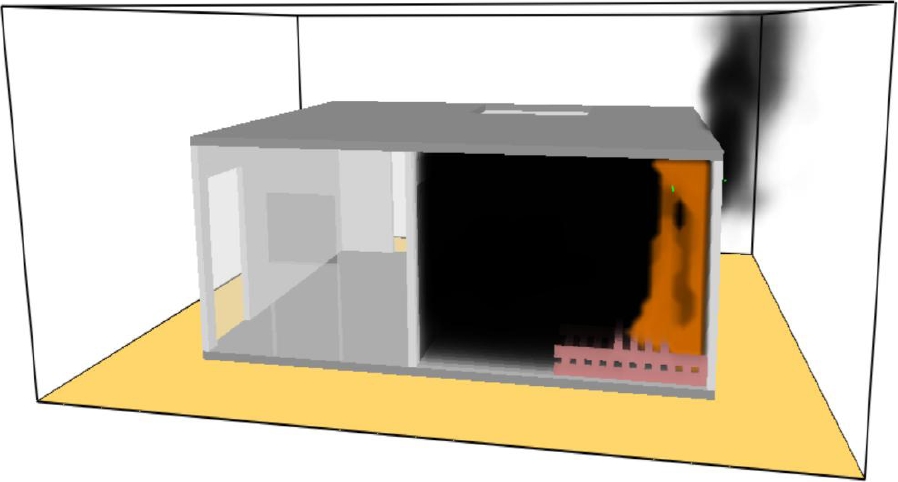
The simulation environment generated by the SMV is shown in Figures 3 and 4, as described in the methodology section.
It should be noted that, to simplify the computational model, the bunk bed was considered a superimposed structure (the upper bunk immediately above the lower bunk), observing the compatible fire load.
4.2 Case 01 – Victim in the center of the room at 1.60 meters
For a victim located in the center of the room in question, considering the height of the airway from the floor (1.60 m), gas concentration and temperature were obtained through the reading devices, and the exposure time was measured, as shown in Table 2 below.
Table 2. Calculation of the area of the modal residential building – Fires in Recife (2011).
| Area in m2 | Number of Fires | Percentage of Total | Mean Area in m2 | Percentage Factor | Weighted Mean in m2 |
| Up to 25 | 06 | 8.96% | 12.5 | 0.0896 | 1.12 |
| 26 to 50 | 20 | 29.85% | 38 | 0.2985 | 11.34 |
| 51 to 75 | 15 | 22.39% | 68 | 0.2239 | 15.23 |
| 76 to 100 | 11 | 16.42% | 88 | 0.1642 | 14.45 |
| 101 to 150 | 9 | 13.43$ | 125.5 | 0.1343 | 16.85 |
| 151 to 200 | 2 | 2.98$ | 175.5 | 0.0298 | 5.23 |
| 201 to 300 | 1 | 1.48% | 250.5 | 0.0148 | 3.73 |
| 301 to 400 | 0 | - | 350.5 | 0 | 0 |
| 401 to 500 | 0 | - | 450.5 | 0 | 0 |
| 501 to 650 | 0 | - | 575.5 | 0 | 0 |
| More tan 650 | 3 | 4.48% | 650 | 0.0448 | 29.12 |
| Totais | 67 | 100% | - | 1.0000 | 97.07 |
Source: Extracted from Corrêa et al., 2018.
In the first minute of the simulation (Table 3), the victim in this room will already notice the heat, which will cause the first thermal effects on their skin, with first-degree burns, as well as the first difficulties in breathing. The concentrations of carbon dioxide (CO2), carbon monoxide (CO), and oxygen (O2) will be increasing, but will still be below the main physiological effects considered in Table 1.
It is important to highlight that the data for the three gases measured in the FDS simulation were compatible (similar), particularly at 1.60 m (victim in the center of the bedroom), with those experimentally verified by Braga et al. (2021). In the aforementioned experiment, using domestic furniture and an equally ventilated environment (with the door slightly open) and similar dimensions, the gases collected and later analyzed in the laboratory show quantities that bear similarities to the computer simulation.
A victim in this situation is expected to, out of his own survival instinct, duck and seek the nearest exit, especially if they are accustomed to the residence. Property or people to protect can modify this behavior, as can attempts to extinguish the fire in its initial phase, increasing the time spent in the fire.
Other factors to consider are the victim's ability to move or difficulties with locking the access door. In this case, if the victim remains standing for longer, breathing difficulties will be observed, which can lead to mental confusion and dizziness, for example. This scenario will occur within 3 minutes, remaining similar until 5 minutes, with physiological deterioration occurring after almost 9 minutes (Table 3). A behavioral hypothesis for this victim, therefore, would be the conscious search for more ventilated areas of the environment, or even the possibility of fainting, followed by a fall between levels, as indicated in Table 3, due to the decrease in available oxygen.
Table 3. Victim in the center of the room at 1.60 meters.
| Parameters/Gases | [CO2]Totais(ppm) | [CO]Totais(ppm) | [O2]Totais% vol | TemperatureTotaisºC |
| Tsimulation1min | 5.898 | 21 | 19,6 | 72,5 |
| Effects | - | - | - | First-degree burn, edema of the upper airways, which may cause respiratory obstruction. |
| Tsimulation 3min | 53.889 | 203 | 13,7 | 212,7 |
| Effects | High respiratory distress; dizziness; mental confusion; headache; feeling short of breath. | - | Reduced judgment; impaired motor coordination; abnormal fatigue after exertion; emotional disturbance. | Almost immediate fatal conditions. |
| Tsimulation 5min | 64.381 | 243 | 12,4 | 241,7 |
| Effects | High respiratory distress; dizziness; mental confusion; headache; feeling short of breath. | - | Reduced judgment; impaired motor coordination; abnormal fatigue after exertion; emotional disturbance. | Almost immediate fatal conditions. |
| End of simulation (525s or 8min45s) | 71.431 | 269 | 11,5 | 266,9 |
| Effects | High respiratory distress; dizziness; mental confusion; headache; feeling short of breath. | - | Severely impaired judgment and coordination; impaired breathing, which can cause permanent heart damage; possibility of fainting within minutes; nausea and vomiting. | Almost immediate fatal conditions. |
Source: Research results, 2025.
It is evident that, around the 9th minute, at a height of approximately 30 cm from the ground, temperatures above 150°C were observed, which will continue to worsen the burns to third-degree, favoring, among other effects, loss of consciousness and immobility (Table 1).
4.3 Case 02 – Victim lying on a single bed
For a victim located on a single bed, isolated, and further from the initial source, there will not be such severe physiological effects in the first minute (see Table 4). People with reduced sensitivity, who are asleep, may not even notice the incident until then.
Table 4. Victim lying on single bed.
| Parameters/Gases | [CO2]Totais(ppm) | [CO]Totais(ppm) | [O2]Totais% vol | TemperatureTotaisºC |
| Tsimulation 1 min | 1.974 | 6 | 20,1 | 42,0 |
| Effects | - | - | - | Initial discomfort, with warming of the upper airways. |
| Tsimulation 3 min | 30.596 | 115 | 16.5 | 124.8 |
| Effects | Moderate difficulty breathing; increased heart rate; increased blood pressure. | - | Impaired thinking and attention; increased heart and respiratory rate; reduced coordination; reduced work capacity; reduced physical and intellectual performance. | Second-degree burns occur within seconds; dehydration and hyperthermia. |
| Tsimulation 5 min | 36.413 | 137 | 15,8 | 130,5 |
| Effects | Moderate difficulty breathing; increased heart rate; increased blood pressure. | - | Impaired thinking and attention; increased heart and respiratory rate; reduced coordination; reduced work capacity; reduced physical and intellectual performance. | Second-degree burns occur within seconds; dehydration and hyperthermia. |
| End of simulation (525s or 8min 45s) | 48.108 | 181 | 14,4 | 181,6 |
| Effects | Moderate difficulty breathing; increased heart rate; increased blood pressure. | - | Reduced judgment; impaired motor coordination; abnormal fatigue after exertion; emotional disturbance. | Third-degree burns; irreversible lung damage; loss of consciousness within seconds. |
Source: Research results, 2025.
Still in Table 4, we can see the increase in carbon dioxide and carbon monoxide concentrations, with a reduction in available oxygen, as expected from combustion, contributing to the victim's greater discomfort. After 5 minutes, the victim will be vulnerable to second-degree burns.
Considering a healthy adult in this position, behavior like that in Case 1 is expected at the same time, when the victim realizes he is engulfed in a fire and will seek an exit by crouching down, away from higher temperatures. However, it is important to emphasize that a sleeping victim, even a healthy one, may naturally have difficulty initially discerning what is happening and how they should act to survive. This may be due to the reduced oxygen levels while he is still asleep, which will reduce his attention and judgment (Table 4); or other factors, such as the presence of smoke, which will reduce visibility of the environment; the distance from the access door; among others.
If the victim remains on the bed, which may happen according to the aforementioned reasons, or even because he has some restriction that prevents him from leaving the room, at 8 minutes and 45 seconds his consciousness will be compromised, leaving him vulnerable to 3rd degree burns. (Table 4).
If nothing is done, this victim will die more quickly than in the first case (unconscious victim, in approximately 9 minutes), with death occurring within the first few minutes. The thermal effects and those related to gas concentration are more severe than those seen in victims close to the floor.
4.4 Case 03 – Victim lying on the bunk bed (lower bed)
The victim in case 3 is the closest to the initial source of the fire. Considering this, he or she will suffer the most intense damage from the fire in the first few seconds, as shown in Table 5 below.
Table 5. Victim lying on the bunk bed (lower bed).
| Parameters/Gases | [CO2]Totais(ppm) | [CO]Totais(ppm) | [O2]Totais% vol | TemperatureTotaisºC |
| Tsimulation 1min | 21.959 | 82 | 17,5 | 272,2 |
| Effects | Mild difficulty breathing. | - | Impaired thinking and attention; increased heart and respiratory rate; reduced coordination; reduced work capacity; reduced physical and intellectual performance. | Almost immediate fatal conditions. |
| Tsimulation 3 min | 44.045 | 166 | 14,7 | 299,1 |
| Effects | Moderate difficulty breathing; increased heart rate; increased blood pressure. | - | Reduced judgment; impaired motor coordination; abnormal fatigue after exertion; emotional disturbance. | Almost immediate fatal conditions. |
| Tsimulation 5 min | 55.637 | 209 | 13,2 | 365,5 |
| Effects | High respiratory distress; dizziness; mental confusion; headache; feeling short of breath. | - | Reduced judgment; impaired motor coordination; abnormal fatigue after exertion; emotional disturbance. | Almost immediate fatal conditions. |
| End of simulation (525s or 8min 45s) | 78.696 | 297 | 10,3 | 639,1 |
| Effects | High respiratory distress; dizziness; mental confusion; headache; feeling short of breath. | - | Severely impaired judgment and coordination; impaired breathing, which can cause permanent heart damage; possibility of fainting within minutes; nausea and vomiting. | Almost immediate fatal conditions. |
Source: Research results, 2025.
The thermal effect will likely be the first factor alerting the victim to the presence of flames, as temperatures conducive to third-degree and fatal burns are quickly reached. Respiratory distress is already observed at this point and rapidly worsens within 5 minutes (Table 5).
A healthy adult may, as a possible hypothesis, follow the same procedure observed in the previous cases: seeking to escape quickly, as this condition will be reached within the first 3 minutes.
On the other hand, the severity observed in Table 5 leads to the possibility of greater human damage in a short period of time. The victim in Case 2, for example, will have more time to assess his actions. The victim in this case, while expecting a faster alert, will have to act more objectively, practically, and precisely—that is, within a few seconds of the onset—since temperatures that cause deeper burns are reached within the first minute (see Table 5).
A victim in this position, nearly 9 minutes into the fire, is not expected to survive, as unconsciousness and fatal temperatures are immediately reached (Table 5). This may occur in cases involving victims with reduced mobility and consciousness.
4.5 Case 04 – Victim lying on the top bunk (upper bunk)
The victim in the top bunk will initially experience a combined effect of reduced oxygen and increased temperature (Table 6). Of the four cases, this victim comes closest to experiencing consequences related to respiratory damage, occurring primarily at the expense of thermal damage. This is because at 3 minutes, the smallest oxygen reduction observed, which would allow unconsciousness while sleeping (Table 6). At this point, it is worth remembering that the simulation environment (upper bunk) was designed immediately above the lower bunk. Under real conditions, the structure of the upper bunk would favor blocking thermal radiation from below, resulting in the formation of a smoke layer just above the ceiling, which would be increasingly approaching the victim. This real-life scenario would favor a reduced perception of the flame temperature, contributing to the victim's engulfment in the smoke cloud.
Table 6. Victim lying on the bunk bed (upper bed).
| Parameters/Gases | [CO2]Totais(ppm) | [CO]Totais(ppm) | [O2]Totais% vol | TemperatureTotaisºC |
| Tsimulation 1 min | 7.873 | 28 | 19,3 | 99.7 |
| Effects | - | - | Impaired thinking and attention; increased heart and respiratory rate; reduced coordination; reduced work capacity; reduced physical and intellectual performance. | First-degree burn. Edema of the upper airways, which may cause respiratory obstruction. |
| Tsimulation 3 min | 55.198 | 208 | 13,5 | 208,5 |
| Effects | High respiratory distress; dizziness; mental confusion; headache; feeling short of breath. | - | Reduced judgment; impaired motor coordination; abnormal fatigue after exertion; emotional disturbance. | Almost immediate fatal conditions. |
| Tsimulation 5 min | 70.838 | 267 | 11,6 | 238,1 |
| Effects | High respiratory distress; dizziness; mental confusion; headache; feeling short of breath. | - | Severely impaired judgment and coordination; impaired breathing, which can cause permanent heart damage; possibility of fainting within minutes; nausea and vomiting. | Almost immediate fatal conditions. |
| End of simulation (525s or 8min 45s) | 82.042 | 310 | 10,1 | 273,9 |
| Effects | Blurred vision; sweating; tremors; unconsciousness, possible death. | - | Severely impaired judgment and coordination; impaired breathing, which can cause permanent heart damage; possibility of fainting within minutes; nausea and vomiting. | Almost immediate fatal conditions. |
Source: Research results, 2025.
Table 6 shows that thermal damage is insignificant compared to respiratory damage.
In Table 6, the simulation ends for Case 4, which has the lowest oxygen reduction of all cases, with the highest concentrations of carbon dioxide and carbon monoxide. The temperature is also elevated, with aggressive physiological effects, but with a slight reduction compared to those in Case 3. In this situation, among the cases, the worsening of the condition of a victim who did not awake due to respiratory intoxication can be expected, remaining amid the fire's development, and dying within a few minutes.
The simulation results of this article and those of Sá (2018) were the same in terms of temperature profiles, overall. Like the scenario used, however, the substantial difference lies in the points of interest for temperature and gas concentration, considering victims in different positions within the room. This enables a discussion, not yet proposed, about the survival of people in a room (a bedroom of a residence) severely affected by fires in the RMR, in Brazil, and worldwide.
5. CONCLUSIONS
The article analyzed a computer simulation of a residential building fire, typical of the city of Recife and the one that produces the highest number of deaths and injuries, not only in that city but also in a number of locations in Brazil and worldwide, as seen in several studies used in the framework.
Four positions were adopted for potential victims with difficulty or inability to move, as follows:
- Victim in the Center of the Room – At 180 seconds (3 min), the combination of temperatures reaching 212°C and a carbon dioxide level of 53,899 ppm would be incompatible with life after a few seconds.
- Victim in the Single Bed – At 525 seconds, even though he were on the opposite side of the fire, the temperature reached 181.6°C, with carbon dioxide and carbon monoxide levels exceeding 48,000 and 181 ppm, respectively, and Oxygen corresponding to 14.4%, a condition unlikely to sustain human life.
- Victim in the lower bunk bed – being the site where the flames began, within 60 seconds it was already burning at 272.2°C, within 180 seconds the temperature reached 299°C. Combined with carbon dioxide levels of 44,045 ppm, it is possible to propose the non-survivability of humans.
- Victim in the upper bunk bed – Oxygen levels of 13.5% would still be bearable, however, 44,045 ppm of carbon dioxide and temperatures above 208°C would make the location lethal 180 seconds after the flames began. It is estimated that the program's limitations (measurement of other gases and heat flux received) and the need to simulate other configurations (fire load, geometry, room, etc.) of fires in residential buildings provide room for improvement and further study.
Given that the literature review revealed the significance of residential fires among all fire occurrences and that they account for most fire-related deaths, the relevance of this study is highlighted, as it addresses a rarely discussed topic: the survival of people inside burning residential buildings. The results raise an important warning, as they indicate a short survival time. Based on the data collected, people with mobility limitations (older people, people with disabilities, children, infants, etc.) or disorientation (hypoxia, exogenous intoxication, opacity in the environment, etc.) would have two lives lost in less than 9 minutes, a time incompatible (in most cases) with identifying the fire, activating the fire service, its displacement, and effective rescue and firefighting actions. It should also be considered that single-family homes (in Brazil) do not have any fire alarm, prevention, or protection systems.
The study also highlights the relevance of analyzing fire data correlating variables such as low oxygen levels, high carbon monoxide levels, and high temperatures as preponderant factors in all phases of the fire for injuries and deaths, comparing different positions of the victims, something little studied in Brazil and Latin America. The result of the study seeks to discuss awareness of the need for fire safety in residential structures, which are not currently covered by current legislation, but which are, for the most part, where structural fires demonstrated in available Brazilian statistical data start. Therefore, the study tacitly proposes that Brazilian legislation adapt the risk level of these structures to building and fire safety codes, encouraging debate on the possibility of installing smoke detectors and/or alarms, as well as exhaust fans, in the rooms of single-family homes, among other tangible measures, seeking to mitigate such deaths. These measures will be the foundation for further studies that prove (or not) the reduction in deaths in these environments. It should be noted that the 'calibration' from the point of view of fire development, temperature profiles and other variables were recorded in a full-scale experiment (Corrêa et. al., 2017) and later in a simulation in FDS, presenting results that are compatible with each other (Sá, 2018) and consequently crediting the data presented here.
6. REFERENCES
Alves, A.B.C.G., Campos, A.T., Braga, G.C.B. (2013). “Simulação Computacional de Incêndio Aplicada ao Projeto de Arquitetura”. In: SEMINÁRIO INTERNACIONAL NUTAU’2013 – Espaço Sustentável: Inovações em Edifícios e Cidades São Paulo/SP (Brasil).
Bispo, R., Marques, F.J., Penha, A. et al. (2023). Uma década de incêndios urbanos: acontecimentos portugueses entre 2013 e 2022. Sci Data10, 569. DOI: https://doi.org/10.1038/s41597-023-02476-6
Braga, G.C.B. (2022). Organização dos Corpos de Bombeiros Militares do Brasil e sua importância para o desenvolvimento das Pesquisas em Prevenção, Combate e Investigação de Incêndios: A Experiência do Corpo de Bombeiros Militar do Distrito Federal (CBMDF). Revista FLAMMAE, 8(24): 09-37. Disponível em:https://www.revistaflammae.com/_files/ugd/08765e_c5f3a02e858a4b219c34276f4f3651f8.pdf
Braga, G.C.B., Corrêa, C., Matos, B., Cavalcanti, J. V. F. L., Lisboa Neto, J.P. (2021). Incêndios em Ambiente com Materiais Brasileiros e Estrangeiros: Um Estudo Comparativo. Revista FLAMMAE, 7(20): 07-29. DOI:https://doi.org/10.17648/2359-4837/flammae.v7n20.p7-29
Braga, G.C.B., Landim, H.R.O. (2008). “Investigação de incendios”. In:A segurança contra incêndio no Brasil. São Paulo: Projeto Editora, pp. 333-45.
Brunetto, L. O. (2015). “Simulação computacional de incêndios: uma aplicação no prédio da escola de engenharia nova da UFRGS”. Monografia Engenharia Civil, Universidade Federal do Rio Grande do Sul (UFRGS), p.105. Disponível em: https://lume.ufrgs.br/handle/10183/148710
Carlos, T. B., Mariani, L. M., Moraes, H. H. Q. (2016). Avaliação do desempenho de sistemas de controle de fumaça por modelagem numérica. Ignis: Revista Técnico Científica do Corpo de Bombeiros Militar de Santa Catarina, Florianópolis (Brasil), Edição Especial: Anais do XVI SENABOM, 1(2): 3-16. Disponível em: https://ignis.emnuvens.com.br/revistaignis/article/view/17/18
Carnieletto, E C., Castro, M. G., Araújo, R. L. (2019). Analise da importância de medidas de Segurança Contra Incêndio em Residências Unifamiliares. Revista FLAMMAE, 5(12):77-103. DOI:https://doi.org/10.17648/2359-4837/flammae.v5n12.p77-103
Carvalho, J. E. C (2013). “Aplicação de fluidodinâmica computacional para análise de segurança de túneis rodoviários sob incêndio”. Dissertação de Mestrado em Engenharia Civil, Programa de Pós-graduação em Engenharia Civil, Universidade Federal do Rio de Janeiro (UFRJ), p.73. Disponível em: https://www.oasisbr.ibict.br/vufind/Record/BRCRIS_6babd31a7238cbcccc745488fb0ff2a9
Corrêa, C. (2024a). Fires In Brazil: Mapping And Lethality. Hygeia: Revista Brasileira de Geografia Médica e da Saúde, 20. DOI: https://doi.org/10.14393/Hygeia2068688
Corrêa, C. (2024b). Incêndios no Brasil: mapeamento e letalidade.Revista GESEC, 15(11): e4402. DOI: https://doi.org/10.7769/gesec.v15i11.4402
Corrêa, C., Rêgo Silva, J. J., Pires, T. A., Braga, G. C. (2015). Mapeamento de Incêndios em Edificações: Um estudo de caso na cidade do Recife. Rev. Eng. Civil IMED, 2(3): 15-34. DOI: https://doi.org/10.18256/2358-6508/rec-imed.v2n3p15-34
Corrêa, C., Rêgo Silva, J. J., Pires, T.A., Braga, G.C.B., Vieira de Melo, I.A. (2018). Edifício Modal: Uma representação para o Estudo de Incêndios na cidade de Recife. Revista Cientec, 8(2):37-46. Disponível em: https://revistas.ifpe.edu.br/cientec/article/view/181
Corrêa, C., Duarte, D.C., Braga, G.C.B (2018). Fragilidade das estatísticas de incêndios estruturais no Brasil. Revista Brasileira de Saúde e Segurança no Trabalho, 1(1):44-49.DOI: https://doi.org/10.37885/210504786
Corrêa, C., Braga, G.C.B, Bezerra Junior, J., Silva, J.J., Tabaczenski, R., Pires, T. A. (2017). Incêndio em compartimento de residência na Cidade do Recife: Um estudo experimental. Revista ALCONPAT, 7(3): 215-230. DOI: https://doi.org/10.21041/ra.v7i3.221n
Corrêa, C. (2017). Mapeamento dos incêndios em edificações: o Edifício Modal e suas aplicações, com foco na cidade de Recife. Tese de Doutorado em Engenharia Civil, Universidade Federal de Pernambuco (UFPE), p.134. Disponível em: https://repositorio.ufpe.br/bitstream/123456789/29575/4/TESE%20Cristiano%20Corr%c3%aaa.pdf
Costa, L. M., Pires, T. A.C., Rêgo Silva, J. J. (2023). Shear strengthening of fire-damaged reinforced concrete beams using NSM CFRP laminates. Engineering Structures, 287: 116175.DOI: https://doi.org/10.1016/j.engstruct.2023.116175
Cunha, L. J. B. F. (2016). “O desempenho da compartimentação horizontal seletiva na promoção da segurança contra incêndio em edificações”. Tese de Doutorado Arquit.e Urb. Universidade Federal do Rio Grande do Norte (UFRN), p.237. Disponível em: https://repositorio.ufrn.br/items/846203ff-cd4c-4178-8231-752b786708e0
Cunha, I.O.P., Lugon, A.P., Bona, B.M. (2018). Investigação experimental e modelagem da dispersão utilizando Fire Dynamics Simulator (FDS) para um vazamento acidental de GLP. Revista FLAMMAE, 4(11):171-188. DOI: https://doi.org/10.17648/2359-4837/flammae.v4n11.p171-188
Dornelas, P., Corrêa, C. (2025). Dimensionamento da Carga de Incêndio em Edificações Residenciais. Revista Multitemas, 30(75) em edição.
Falcão, G. M. (2024). Perfil de Ocorrências de Incêndio em Edificações atendidas pelo CBMMG de 2018 a 2023. Revista FLAMMAE, 10(30):01-43. Disponível em: https://www.revistaflammae.com/_files/ugd/08765e_abe2b855cffd4a248a6d89344d4a73ac.pdf
Fontenelle, F. M. A. (2012). Análise Térmica em Estruturas de Tanques de Armazenamento de Etanol em Situação de Incêndio. Dissertação de Mestrado em Engenharia Civil, Universidade Federal do Rio de Janeiro (UFRJ), p.112.
Hahnemann, A. L. C., Corrêa, C., Rabbani, E. R. K. (2017). Evaluación de seguridad contra incendio: método alternativo aplicado a edificaciones brasileña. Revista ALCONPAT, 7(2):186-199. DOI: https://doi.org/10.21041/ra.v7i1.178
Hennemann, G. G., Gil, A. M., Bolina, F. L., Rodrigues, E. E., Tutikian, B. F., Braga, G.C. (2018). Modelling the influence of crowd control railings on the Kiss nightclub evacuation.FireResearch, 2(1). DOI: https://doi.org/10.4081/fire.2018.49
Laím, L., Rodrigues, J.P.C., da Silva, L.S. (2014). Experimental analysis on cold-formed steel beams subjected to fire. Thin-WalledStructures, 74:104-117. DOI: https://doi.org/10.1016/j.tws.2013.09.006
Mariani, L. M., Carlos, T. B. (2017). Estudo de evacuação em edificação em Brasília com o uso do FDS-EVAC. Ignis: Revista Técnico Científica do Corpo de Bombeiros Militar de Santa Catarina, Florianópolis (Brasil), Edição Especial: Anais do XVI SENABOM, v.1(2):120-134. Disponível em: https://ignis.emnuvens.com.br/revistaignis/article/view/30/40
Matos, L. V (2017). “Estudo numérico do escoamento de gases por uma abertura durante um incêndio em ambiente conjugado”. Monografia Engenharia Mecânica, Universidade Federal do Rio Grande do Sul (UFRGS), p.125. Disponível em: https://lume.ufrgs.br/handle/10183/177155
Mazzoni, F., Klein, D. L (2015). “Análise da Propagação de Incêndio em Prédios Altos através da Simulação Computacional”. In: 3° CILASCI, Congresso Ibero-Latino-Americano sobre Segurança Contra Incêndios, Porto Alegre/RS (Brasil).
McGrattan, K., Hostikka, S., McDermott, R., Floyd, J., Weinschenk, C., Overholt, K (2019). “Fire Dynamics Simulator – User’s Guide: 9a Edition. NIST” – Special Publication 1019: National Institute of Standards and Technology – NIST & Technical Research Centre of Finland – VTT, Maryland (EUA).
Menezes, R.R.F, Corrêa, C. (2022), ‘Entre mortos e feridos’: mapeamento, caracterização e análise dos incêndios com vítimas na região metropolitana do Recife. OPEN SCIENCE RESEARCH VI, v. 6(1): 1493-1508, 2022. DOI: https://doi.org/10.37885/220910029
Pignatta e Silva, V., Rodrigues, F. C., Fakury, R. H., Pannoni, F. D. (2007). Incêndio real em um apartamento de interesse social-um estudo de caso. Rem: Revista Escola de Minas, 60(2):315-324. DOI: https://doi.org/10.1590/S0370-44672007000200014
Rodrigues, E.E.C., Rodrigues, J.P.C., Silva Filho, L.C.P. (2017). Comparative study of building fire safety regulations in different Brazilian states. Journal of Building Engineering, v.10 :102-108. DOI: https://doi.org/10.1016/j.jobe.2017.03.001
Rodrigues, E. E. C. (2016). “A Sistema de Gestão da Segurança Contra Incêndio e Pânico nas edificações: fundamentação para uma regulamentação nacional”. Tese de Doutorado em Engenharia Civil, Universidade Federal do Rio Grande do Sul (UFRGS), p.178. Disponível em: https://www.lume.ufrgs.br/handle/10183/142695
Rodrigues, E. E. C. (2009). “Análise da eficiência dos sistemas de compartimentação vertical externa por afastamento entre janelas e por projeções horizontais segundo as exigências normativas brasileiras”. Dissertação em Engenharia Civil, Universidade Federal do Rio Grande do Sul (UFRGS), p.178. Disponível em: https://lume.ufrgs.br/handle/10183/19045
Ruschel, F. (2011). “Avaliação da utilização de ferramentas de simulação computacional para reconstituição de incêndios em edificações de concreto armado: aplicação ao caso Shopping Total em Porto Alegre – RS”. Dissertação de Mestrado em Engenharia Civil, Universidade Federal do Rio Grande do Sul (UFRGS), p.131. Disponível em: https://lume.ufrgs.br/handle/10183/29047
Sá, R.T. (2018). “Simulação numérica de incêndios em edificações”. Dissertação de Mestrado em Engenharia Civil, Universidade Federal de Pernambuco, p.218. Disponível em: https://repositorio.ufpe.br/handle/123456789/29684
Santos, J. (2024). “Incêndios com Mortos e Feridos em Belo Horizonte: Caracterização e Análise”. Trabalho de Conclusão de Curso de Especialização em Engenharia de Incêndio, Universidade Federal de Pernambuco, p.124.
Santos, J., Corrêa, C., Krüger, P.G. (2024). Incêndios com Mortos e Feridos em Belo Horizonte: Caracterização e análise. Revista FLAMMAE (em edição), 2025.
Santos, M.P. (2016). Uso de detectores para a redução de Mortes ocasionadas por Incêndios em Residências Unifamiliares. Revista FLAMMAE, 2(3):262-264. DOI: https://doi.org/10.21628/2359-4837/flammae.v2n3p262-264
Silva Filho, L. C. P., Rushchel, F., Dolvitsch, J., Lima, R. C. A., Braga, G.B. (2011). Utilização de Métodos Computacionais na Reconstituição de Incêndios: Aplicação ao caso do Shopping Total. Revista Sul-Americana de Engenharia Estrutural, 8(3):52-64. Disponível em: https://seer.upf.br/index.php/rsaee/article/view/2609
Vasconcelos, G. M. A., Pires, T.A.C., Rêgo Silva, J.J. (2023). Structural and fire performance of masonry walls with ceramic bricks.Engineering Structures, v. 291, p. 116399.DOI: https://doi.org/10.1016/j.engstruct.2023.116399
Xiong, Y., Zhang, C., Qi, H., Liu, X. (2022). Characteristics and Situation of Fire in China From 1999 to 2019: A Statistical Investigation. Front. Environ. Sci. 10:945171., 2022. DOI: https://doi.org/10.3389/fenvs.2022.945171
Tabaczenski, R., Corrêa, C., Santos, M. M., Pires, T. A., Silva, J. J. R. (2017). Aplicação do software fire dynamics simulator (FDS) no estudo da segurança contra incêndios (SCI) no Brasil. Revista FLAMMAE, 3(7):87-116. DOI: https://doi.org/10.17648/2359-4837/flammae.v3n7.p87-116
ANNEXES
APPENDIX 1 – COMPUTER SIMULATION IMAGES
Time = 0,0 s
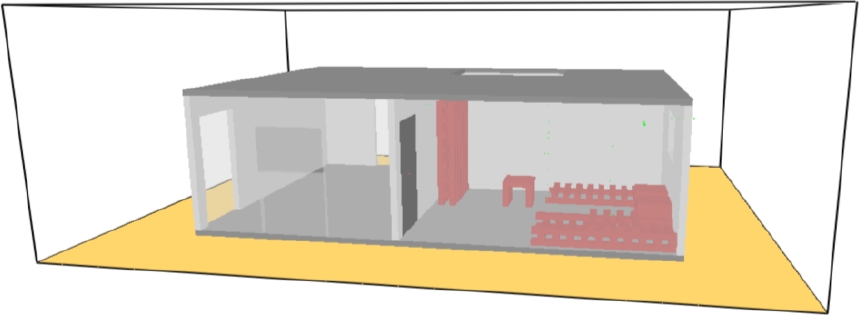
Time = 30,0 s
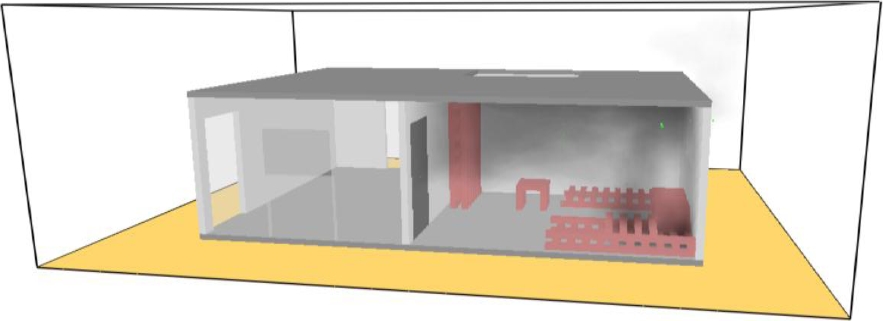
Time = 1 min
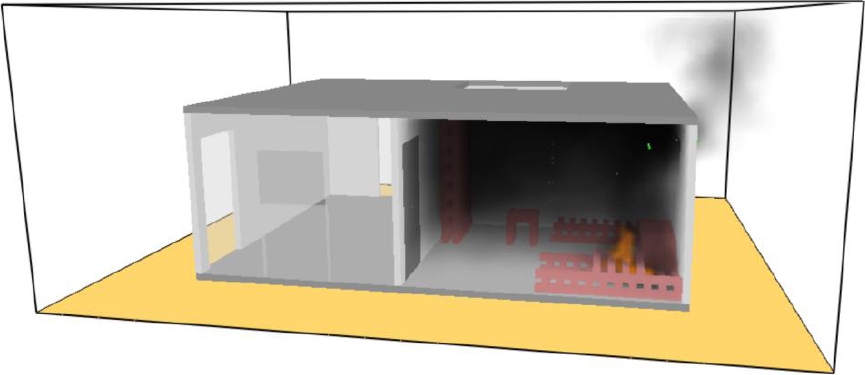
Time = 2 min
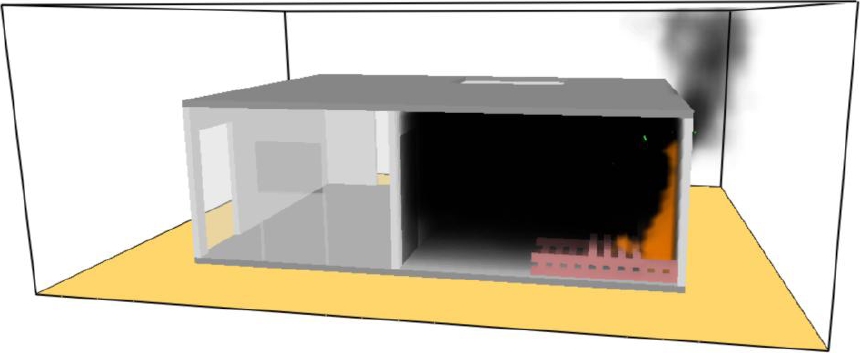
Time = 3 min
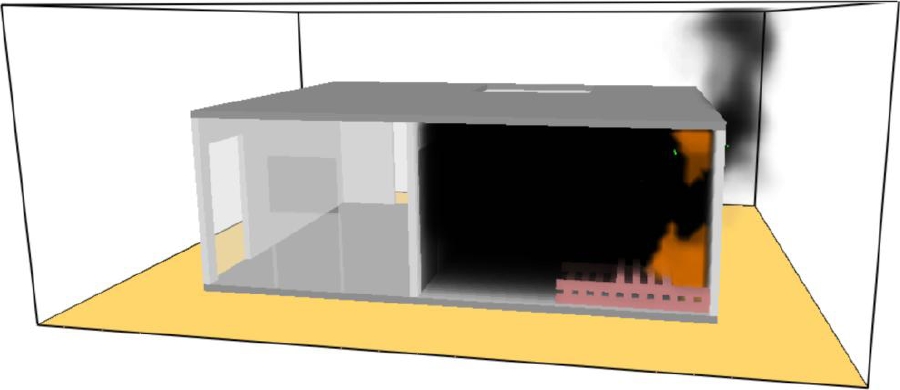
Time = 5 min
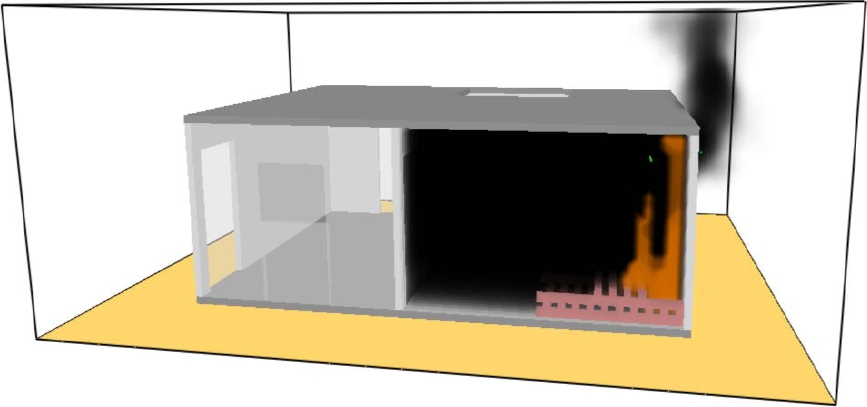
Time = 8min 45s
APPENDIX 02 – SOURCE CODE OF THE COMPUTER SIMULATION
&HEAD CHID = 'artigo', TITLE = 'Artigo'/
------------------------------------------------------------------
---------------------------
DEFINIÇÃO DA MALHA (10 cm):
---------------------------
&MESH IJK=100,75,40, XB=-1.5,8.5,-3.0,4.5,-0.1,3.9 /
------------------------------------------------------------------
---------------------------
DEFINIÇÃO DO TEMPO DE SIMULAÇÃO (EM SEGUNDOS):
---------------------------
&TIME T_END=3000.0 /
&DUMP DT_RESTART=10.0 / cria arquivos de restart a cada 10 s de
simulação
------------------------------------------------------------------
-----------------------------
PARÂMETROS INICIAIS DO AMBIENTE:
-----------------------------
TEMPERATURA AMBIENTE = 29.5°c
PRESSÃO ATMOSFÉRICA = 101325 Pa
HUMIDADE DO AR = 80%
VENTO DE 3 m por s À 45°
U 0 = 3*cos(45) = 2.12
V 0 = 3*sen(45) = 2.12
&MISC TMPA=29.5,
P_INF=101325.0,
HUMIDITY=80.0,
/
&WIND U0=2.12,
V0=2.12
/
>>> caso seja necessário, para iniciar um restart deve-se ativar
este comando na namelistmisc
------------------------------------------------------------------
---------------------------
ABRINDO A MALHA PARA O EXTERIOR (INTERAÇÃO COM O AMBIENTE):
---------------------------
&VENT MB='XMIN', SURF_ID='OPEN' /
&VENT MB='XMAX', SURF_ID='OPEN' /
&VENT MB='YMIN', SURF_ID='OPEN' /
&VENT MB='YMAX', SURF_ID='OPEN' /
&VENT MB='ZMAX', SURF_ID='OPEN' /
------------------------------------------------------------------
---------------------------
REAÇÃO GASOSA DO INCÊNDIO:
---------------------------
Em uma simulação de incêndio no FDS, há apenas um combustível
gasoso que atua como um substituto para todas as fontes de
combustível em potencial.
&SPEC ID='madeira', FORMULA='CH1.7O0.74N0.002' /
&REAC ID='MADEIRA'
FUEL='madeira'
HEAT_OF_COMBUSTION=17500.0
SOOT_YIELD=0.015
CO_YIELD=0.004 /
------------------------------------------------------------------
---------------------------
MATERIAIS NÃO COMBUSTÍVEIS:
---------------------------
Propriedades obtidas de ABNT NBR 15220 (2003)
----------
TIJOLO CERÂMICO:
DENSIDADE = 1400 kg por m³
CONDUTIVIDADE TÉRMICA = 0.9 W por m.K
CALOR ESPECIFICO = 0.92 kJ por (kg.K)
EMISSIVIDADE = 0.9
&MATL ID='TIJOLO'
DENSITY=1400.0
CONDUCTIVITY=0.9
SPECIFIC_HEAT=0.92
EMISSIVITY=0.9 /
----------
ARGAMASSA DE GESSO:
DENSIDADE = 1200 kg por m³
CONDUTIVIDADE TÉRMICA = 0.7 W por m.K
CALOR ESPECIFICO = 0.84 kJ por (kg.K)
EMISSIVIDADE = 0.9
&MATL ID='A_GESSO'
DENSITY=1200.0
CONDUCTIVITY=0.7
SPECIFIC_HEAT=0.84
EMISSIVITY=0.9 /
----------
REAÇÃO GASOSA DO INCÊNDIO:
---------------------------
Em uma simulação de incêndio no FDS, há apenas um combustível
gasoso que atua como um substituto para todas as fontes de
combustível em potencial.
&SPEC ID='madeira', FORMULA='CH1.7O0.74N0.002' /
&REAC ID='MADEIRA'
FUEL='madeira'
HEAT_OF_COMBUSTION=17500.0
SOOT_YIELD=0.015
CO_YIELD=0.004 /
------------------------------------------------------------------
---------------------------
MATERIAIS NÃO COMBUSTÍVEIS:
---------------------------
Propriedades obtidas de ABNT NBR 15220 (2003)
----------
TIJOLO CERÂMICO:
DENSIDADE = 1400 kg por m³
CONDUTIVIDADE TÉRMICA = 0.9 W por m.K
CALOR ESPECIFICO = 0.92 kJ por (kg.K)
EMISSIVIDADE = 0.9
&MATL ID='TIJOLO'
DENSITY=1400.0
CONDUCTIVITY=0.9
SPECIFIC_HEAT=0.92
EMISSIVITY=0.9 /
----------
ARGAMASSA DE GESSO:
DENSIDADE = 1200 kg por m³
CONDUTIVIDADE TÉRMICA = 0.7 W por m.K
CALOR ESPECIFICO = 0.84 kJ por (kg.K)
EMISSIVIDADE = 0.9
&MATL ID='A_GESSO'
DENSITY=1200.0
CONDUCTIVITY=0.7
SPECIFIC_HEAT=0.84
EMISSIVITY=0.9 /
----------
ARGAMASSA DE CIMENTO:
DENSIDADE = 2000 kg por m³
CONDUTIVIDADE TÉRMICA = 1.15 W por m.K
CALOR ESPECIFICO = 1.0 kJ por (kg.K)
EMISSIVIDADE = 0.9
&MATL ID='A_CIMENTO'
DENSITY=2000.0
CONDUCTIVITY=1.15
SPECIFIC_HEAT=1.0
EMISSIVITY=0.9 /
----------
CONCRETO:
DENSIDADE = 2300 kg por m³
CONDUTIVIDADE TÉRMICA = 1.75 W porm.K
CALOR ESPECIFICO = 1.0 kJ por (kg.K)
EMISSIVIDADE = 0.9
&MATL ID='CONCRETO'
DENSITY=2300.0
CONDUCTIVITY=1.75
SPECIFIC_HEAT=1.0
EMISSIVITY=0.9 /
----------
&SURF ID='PISO', COLOR='GRAY', MATL_ID='CONCRETO', THICKNESS=0.1, BACKING='EXPOSED'/
----------
&SURF ID='TETO'
COLOR='GRAY'
MATL_ID='TIJOLO','CONCRETO'
THICKNESS=0.07,0.03
BACKING='EXPOSED' /
----------
&SURF ID='PAREDE_CIMENTO'
COLOR='SILVER'
MATL_ID='A_CIMENTO','TIJOLO','A_CIMENTO'
THICKNESS = 0.025,0.1,0.025
BACKING='EXPOSED' /
----------
&SURF ID='PAREDE_CHAPISCADA'
COLOR='SILVER'
MATL_ID='A_CIMENTO','TIJOLO','A_CIMENTO'
THICKNESS = 0.01,0.1,0.025
BACKING='EXPOSED' /
----------
&SURF ID='PAREDE_GESSO'
COLOR='SILVER'
MATL_ID='A_GESSO','TIJOLO','A_CIMENTO'
THICKNESS = 0.025,0.1,0.025
BACKING='EXPOSED' /
------------------------------------------------------------------
---------------------------
MATERIAIS COMBUSTÍVEIS:
---------------------------
----------
MADEIRA:
DENSIDADE = 400 kg/m³
EMISSIVIDADE = 0.9
CONDUTIVIDADE TÉRMICA = 0.12 W/m.K
CALOR ESPECIFICO = 1.34 kJ/(kg.K)
CALOR DE COMBUSTÃO = 17500 kJ/kg
TEMPERATURA DE IGNIÇÃO = 210 °C
TAXA DE LIBERAÇÃO DE CALOR = 100 kW/m²
&MATL ID='MADEIRA'
SPECIFIC_HEAT=1.34
CONDUCTIVITY=0.12
EMISSIVITY=0.9
DENSITY=400.0
HEAT_OF_COMBUSTION=17500.0 /
----------
&SURF ID='MAD'
COLOR='BROWN'
BURN_AWAY=.TRUE.
BACKING='EXPOSED'
MATL_ID='MADEIRA'
THICKNESS=0.1
IGNITION_TEMPERATURE=210
HRRPUA=100 /
------------------------------------------------------------------
---------------------------
GEOMETRIA DO COMPARTIMENTO:
---------------------------
----------
PISO:
&OBST XB=-0.1,7.1,-1.7,3.1,-0.1,0.0, SURF_ID='PISO' /
----------
TETO:
&OBST XB=-0.1,1.8,-1.7,-0.1,2.4,2.5, SURF_ID='TETO' /
&OBST XB=1.8,3.9,-1.7,-1.6,2.4,2.5, SURF_ID='TETO' /
&OBST XB=3.9,7.1,-1.7,-0.1,2.4,2.5, SURF_ID='TETO' /
&OBST XB=-0.1,7.1,-0.1,3.1,2.4,2.5, SURF_ID='TETO' /
----------
PAREDE P7:
&OBST XB=-0.1,0.0,-1.7,-0.1,0.0,2.4, SURF_ID='PAREDE_CIMENTO' /
----------
PAREDE P1 (considerado a abertura da janela J01):
&OBST XB=-0.1,0.0,-0.1,1.0,0.0,2.4, SURF_ID='PAREDE_CHAPISCADA' /
&OBST XB=-0.1,0.0,1.0,2.0,0.0,1.2, SURF_ID='PAREDE_CHAPISCADA' /
&OBST XB=-0.1,0.0,1.0,2.0,2.0,2.4, SURF_ID='PAREDE_CHAPISCADA' /
&OBST XB=-0.1,0.0,2.0,3.1,0.0,2.4, SURF_ID='PAREDE_CHAPISCADA' /
----------
PAREDE P3 (considerando a abertura da porta P01):
&OBST XB=3.9,4.0,-0.1,2.1,0.0,2.4, SURF_ID='PAREDE_CIMENTO' /
&OBST XB=3.9,4.0,2.1,2.9,2.0,2.4, SURF_ID='PAREDE_CIMENTO' /
&OBST XB=3.9,4.0,2.9,3.1,0.0,2.4, SURF_ID='PAREDE_CIMENTO' /
----------
Considerando que a porta foi abertura em 1080 segundos:
&OBST XB=3.9,4.0,2.1,2.9,0.0,2.0, SURF_ID='PAREDE_CIMENTO',
COLOR='BLACK', DEVC_ID='tempo01' /
&DEVC XYZ=3.9,2.5,1.0, ID ='tempo01', SETPOINT= 1080.0,
QUANTITY='TIME', INITIAL_STATE=.true. /
----------
PAREDE P6 (considerando a abertura da porta P02):
&OBST XB=7.0,7.1,-1.7,2.0,0.0,2.4, SURF_ID='PAREDE_CIMENTO' /
&OBST XB=7.0,7.1,2.0,2.9,2.0,2.4, SURF_ID='PAREDE_CIMENTO' /
&OBST XB=7.0,7.1,2.9,3.1,0.0,2.4, SURF_ID='PAREDE_CIMENTO' /
----------
PAREDE P2:
&OBST XB=0.0,3.9,3.0,3.1,0.0,2.4, SURF_ID='PAREDE_GESSO',
COLOR='SILVER', TRANSPARENCY=0.5 /
----------
PAREDE P5 (considerado a abertura da janela J02):
&OBST XB=4.0,5.0,3.0,3.1,0.0,2.4, SURF_ID='PAREDE_CIMENTO',
COLOR='SILVER', TRANSPARENCY=0.5 /
&OBST XB=5.0,6.0,3.0,3.1,0.0,1.1, SURF_ID='PAREDE_CIMENTO',
COLOR='SILVER', TRANSPARENCY=0.5 /
&OBST XB=5.0,6.0,3.0,3.1,1.9,2.4, SURF_ID='PAREDE_CIMENTO',
COLOR='SILVER', TRANSPARENCY=0.5 /
&OBST XB=6.0,7.0,3.0,3.1,0.0,2.4, SURF_ID='PAREDE_CIMENTO',
COLOR='SILVER', TRANSPARENCY=0.5 /
----------
PAREDE P4:
&OBST XB=0.0,3.9,-0.1,0.0,0.0,2.4, SURF_ID='PAREDE_CHAPISCADA' /
----------
PAREDE P8 (considerando a abertura da porta P03):
&OBST XB=0.0,5.0,-1.7,-1.6,0.0,2.4, SURF_ID='PAREDE_CIMENTO' /
&OBST XB=5.0,5.9,-1.7,-1.6,2.0,2.4, SURF_ID='PAREDE_CIMENTO' /
&OBST XB=5.9,7.0,-1.7,-1.6,0.0,2.4, SURF_ID='PAREDE_CIMENTO' /
----------
ESCADA:
&MULT ID='escada', DXB=-0.2,-0.2,0.0,0.0,0.2,0.2, N_LOWER=0,
N_UPPER=11 /
&OBST XB=3.8,4.0,-1.6,-0.1,0.0,0.2, MULT_ID='escada',
SURF_ID='PISO' /
------------------------------------------------------------------
---------------------------
CARGA DE INCÊNDIO:
---------------------------
----------
CAMA + COLCHÃO:
&MULT ID='C1', DY=0.7, DX0=0.0, DY0=0.0, DZ0=0.0, J_LOWER=0,
J_UPPER=1 /
&OBST XB=0.0,2.0,0.0,0.1,0.0,0.1, MULT_ID='C1', SURF_ID='MAD' /
&MULT ID='C2', DX=0.2, DX0=0.0, DY0=0.0, DZ0=0.1, I_LOWER=0,
I_UPPER=9 /
&OBST XB=0.0,0.1,0.0,0.8,0.0,0.1, MULT_ID='C2', SURF_ID='MAD' /
----------
BELICHE + COLCHÃO:
&MULT ID='B1', DY=0.7, DX0=0.0, DY0=2.2, DZ0=0.0, J_LOWER=0,
J_UPPER=1 /
&OBST XB=0.0,2.0,0.0,0.1,0.0,0.1, MULT_ID='B1', SURF_ID='MAD' /
&MULT ID='B2', DX=0.2, DX0=0.0, DY0=2.2, DZ0=0.1, I_LOWER=0,
I_UPPER=9 /
&OBST XB=0.0,0.1,0.0,0.8,0.0,0.1, MULT_ID='B2', SURF_ID='MAD' /
&MULT ID='B3', DY=0.7, DX0=0.0, DY0=2.2, DZ0=0.2, J_LOWER=0,
J_UPPER=1 /
&OBST XB=0.0,2.0,0.0,0.1,0.0,0.1, MULT_ID='B3', SURF_ID='MAD' /
&MULT ID='B4', DX=0.2, DX0=0.5, DY0=2.2, DZ0=0.3, I_LOWER=0,
&OBST XB=0.0,0.1,0.0,0.8,0.0,0.1, MULT_ID='B4', SURF_ID='MAD' /
----------
CRIADO MUDO 1 + VENTILADOR:
&MULT ID='CM1', DY=0.4, DX0=0.0, DY0=0.9, DZ0=0.0, J_LOWER=0,
J_UPPER=1 /
&OBST XB=0.0,0.5,0.0,0.1,0.0,0.4, MULT_ID='CM1', SURF_ID='MAD' /
&OBST XB=0.0,0.5,0.9,1.4,0.4,0.5, SURF_ID='MAD' /
----------
CRIADO MUDO 2 + VENTILADOR:
&MULT ID='CM2', DY=0.4, DX0=0.0, DY0=1.6, DZ0=0.0, J_LOWER=0,
J_UPPER=1 /
&OBST XB=0.0,0.5,0.0,0.1,0.0,0.4, MULT_ID='CM2', SURF_ID='MAD' /
&OBST XB=0.0,0.5,1.6,2.1,0.4,0.5, SURF_ID='MAD' /
----------
CRIADO MUDO 3 + TELEVISOR:
&MULT ID='CM3', DX=0.4, DX0=2.2, DY0=0.6, DZ0=0.0, I_LOWER=0,
I_UPPER=1 /
&OBST XB=0.0,0.1,0.0,0.5,0.0,0.4, MULT_ID='CM3', SURF_ID='MAD' /
&OBST XB=2.2,2.7,0.6,1.1,0.4,0.5, SURF_ID='MAD' /
----------
GUARDA-ROUPAS + ROUPAS + PAPÉIS:
&MULT ID='GR1', DY=0.2, DX0=3.5, DY0=0.1, DZ0=0.0, J_LOWER=0,
J_UPPER=5 /
&OBST XB=0.0,0.1,0.0,0.1,0.0,2.1, MULT_ID='GR1', SURF_ID='MAD' /
&MULT ID='GR2', DZ=0.3, DX0=3.6, DY0=0.0, DZ0=0.2, K_LOWER=0,
K_UPPER=6 /
&OBST XB=0.0,0.1,0.0,1.3,0.0,0.1, MULT_ID='GR2', SURF_ID='MAD' /
&MULT ID='GR3', DY=0.2, DX0=3.7, DY0=0.1, DZ0=0.0, J_LOWER=0,
J_UPPER=5 /
&OBST XB=0.0,0.1,0.0,0.1,0.0,2.1, MULT_ID='GR3', SURF_ID='MAD' /
------------------------------------------------------------------
---------------------------
QUEIMADOR PARA IGNIÇÃO DO INCÊNDIO:
---------------------------
&SURF ID='QUEIMADOR'
COLOR='RED'
HRRPUA=3000.0
RAMP_Q = 'fire_ramp' /
&RAMP ID='fire_ramp', T=0.0, F=0.0 /
&RAMP ID='fire_ramp', T=30.0, F=1.0 /
&RAMP ID='fire_ramp', T=120.0, F=1.0 /
&RAMP ID='fire_ramp', T=150.0, F=0.0 /
&VENT XB=1.1,1.2,2.3,2.4,0.0,0.0, SURF_ID='QUEIMADOR' /
------------------------------------------------------------------
---------------------------
MEDIDORES:
---------------------------
----------
TERMOPARES:
----------
NO CENTRO DO COMPARTIMENTO:
&DEVC XYZ=1.9,1.5,0.3, QUANTITY='TEMPERATURE', ID='H30' /
&DEVC XYZ=1.9,1.5,0.6, QUANTITY='TEMPERATURE', ID='H60' /
&DEVC XYZ=1.9,1.5,0.9, QUANTITY='TEMPERATURE', ID='H90' /
&DEVC XYZ=1.9,1.5,1.2, QUANTITY='TEMPERATURE', ID='H120' /
&DEVC XYZ=1.9,1.5,1.5, QUANTITY='TEMPERATURE', ID='H150' /
&DEVC XYZ=1.9,1.5,1.8, QUANTITY='TEMPERATURE', ID='H180' /
&DEVC XYZ=1.9,1.5,2.1, QUANTITY='TEMPERATURE', ID='H210' /
&DEVC XYZ=1.9,1.5,2.3, QUANTITY='TEMPERATURE', ID='H230' /
&DEVC XYZ=1.9,1.5,1.6, QUANTITY='VOLUME FRACTION',
SPEC_ID='CARBON DIOXIDE', ID='CO2_PESSOA_CENTRO'/
&DEVC XYZ=1.9,1.5,1.6, QUANTITY='VOLUME FRACTION',
SPEC_ID='OXYGEN', ID='O2_PESSOA_CENTRO'/
&DEVC XYZ=1.9,1.5,1.6, QUANTITY='VOLUME FRACTION',
SPEC_ID='CARBON MONOXIDE', ID='CO_PESSOA_CENTRO'/
&DEVC XYZ=1.9,1.5,1.6, QUANTITY='TEMPERATURE', ID='H160' /
----------
PAREDE P3:
&DEVC XYZ=3.9,1.6,2.1, QUANTITY='WALL TEMPERATURE', IOR=-1,
ID='09' / na face, do lado de dentro do dormitório
&DEVC XYZ=3.8,1.6,2.1, QUANTITY='TEMPERATURE', ID='09G' / no gás,
do lado de dentro do dormitório
&DEVC XYZ=4.0,1.6,2.1, QUANTITY='WALL TEMPERATURE', IOR=1, ID='10'
/ na face, do lado de fora do dormitório
&DEVC XYZ=4.1,1.6,2.1, QUANTITY='TEMPERATURE', ID='10G' / no gás,
do lado de fora do dormitório
----------
PAREDE P2:
&DEVC XYZ=0.5,3.0,2.1, QUANTITY='WALL TEMPERATURE', IOR=-2,
ID='11' / na face, do lado de dentro do dormitório
&DEVC XYZ=0.5,2.9,2.1, QUANTITY='TEMPERATURE', ID='11G' / no gás,
do lado de dentro do dormitório
&DEVC XYZ=0.5,3.1,2.1, QUANTITY='WALL TEMPERATURE', IOR=2, ID='12'
/ na face, do lado de fora do dormitório
&DEVC XYZ=0.5,3.2,2.1, QUANTITY='TEMPERATURE', ID='12G' / no gás,
do lado de fora do dormitório
----------
PAREDE P1:
&DEVC XYZ=0.0,2.5,2.1, QUANTITY='WALL TEMPERATURE', IOR=1, ID='13'
/ na face, do lado de dentro do dormitório
&DEVC XYZ=0.1,2.5,2.1, QUANTITY='TEMPERATURE', ID='13G' / no gás,
do lado de dentro do dormitório
&DEVC XYZ=-0.1,2.5,2.1, QUANTITY='WALL TEMPERATURE', IOR=-1,
ID='14' / na face, do lado de fora do dormitório
&DEVC XYZ=-0.2,2.5,2.1, QUANTITY='TEMPERATURE', ID='14G' / no gás,
do lado de fora do dormitório
----------
ALTURA DA CAMADA LIVRE DE FUMAÇA NO COMPARTIMENTO:
&DEVC XB=1.9,1.9,1.5,1.5,0.0,2.4, QUANTITY='LAYER HEIGHT',
ID='ACF_Comp' /
----------
CONCENTRAÇÃO DE OXIGÊNIO NO COMPARTIMENTO:
&DEVC XB=0.0,3.9,0.0,3.0,0.0,2.4, QUANTITY='MASS FRACTION',
SPEC_ID='OXYGEN', ID='COx_Comp'/
----------
ANALISE DO ARTIGO PERICIA:
&DEVC XYZ=0.9,2.5,0.4, QUANTITY='VOLUME FRACTION',
SPEC_ID='CARBON DIOXIDE', ID='CO2_BEL_BAIXO'/
&DEVC XYZ=0.9,2.5,0.4, QUANTITY='VOLUME FRACTION',
SPEC_ID='OXYGEN', ID='O2_BEL_BAIXO'/
&DEVC XYZ=0.9,2.5,0.4, QUANTITY='VOLUME FRACTION',
SPEC_ID='CARBON MONOXIDE', ID='CO_BEL_BAIXO'/
&DEVC XYZ=0.9,2.5,0.4, QUANTITY='TEMPERATURE', ID='TEMP_GAS_BEL_BAIXO' /
&DEVC XYZ=0.9,2.5,1.6, QUANTITY='VOLUME FRACTION',
SPEC_ID='CARBON DIOXIDE', ID='CO2_BEL_CIMA'/
&DEVC XYZ=0.9,2.5,1.6, QUANTITY='VOLUME FRACTION',
SPEC_ID='OXYGEN', ID='O2_BEL_CIMA'/
&DEVC XYZ=0.9,2.5,1.6, QUANTITY='VOLUME FRACTION',
SPEC_ID='CARBON MONOXIDE', ID='CO_BEL_CIMA'/
&DEVC XYZ=0.9,2.5,1.6, QUANTITY='TEMPERATURE', ID='TEMP_GAS_BEL_CIMA' /
&DEVC XYZ=0.9,0.4,0.4, QUANTITY='VOLUME FRACTION',
SPEC_ID='CARBON DIOXIDE', ID='CO2_CAMA'/
&DEVC XYZ=0.9,0.4,0.4, QUANTITY='VOLUME FRACTION',
SPEC_ID='OXYGEN', ID='O2_CAMA'/
&DEVC XYZ=0.9,0.4,0.4, QUANTITY='VOLUME FRACTION',
SPEC_ID='CARBON MONOXIDE', ID='CO_CAMA'/
&DEVC XYZ=0.9,0.4,0.4, QUANTITY='TEMPERATURE', ID='TEMP_GAS_CAMA' /
----------
PLANO DE TEMPERATURAS DOS GASES:
&SLCF PBY=1.5, QUANTITY='TEMPERATURE', VECTOR=.TRUE.,
ID='PerfilTemp_Y150' /
------------------------------------------------------------------
&TAIL / FIM DO ARQUIVO