
| Basic Research | https://doi.org/10.21041/ra.v14i2.680 |
Technical and cost impact of differences in functional classification of road pavements
Impacto técnico y económico de las diferencias en la clasificación funcional de los pavimentos de las carreteras
Impacto técnico e de custos das diferenças de classificação funcional de pavimentos rodoviários
J. L.C. Sousa1* , C. L. Maia1, S. D. Vasconcelos1, F. H. L. Oliveira1
1 Department of Transportation Engineering, Federal University of Ceará (UFC), Fortaleza, Brazil.
*Contact author: levi.chaves@det.ufc.br
Received: 03/03/2024
Revised: 16/04/2024
Accepted: 24/04/2024
Published: 15/05/2024
| Cite as: Sousa, J. L. C., Maia, C. L., Vasconcelos, S. D., Oliveira, F. H. L. (2024), "Technical and cost impact of differences in functional classification of road pavements", Revista ALCONPAT, 14 (2), pp. 211 - 223, DOI: https://doi.org/10.21041/ra.v14i2.680 |
ABSTRACT
This work aims to analyze whether there are differences in the classification of the condition of a flexible road pavement using Continuous Visual Survey (LVC) and the Global Gravity Index (IGG). A section of a road paved with Asphalt Concrete was selected to assess the costs associated with each classification. Due to the longer time required for obtaining IGG, the analysis was limited to this section. The results revealed discrepancies in classifications and costs between the methods in the initial segments of the road. It was concluded that LVC provided better results than IGG, attributed to the inherent subjectivity of human assessment. Additionally, it was observed that the two methods complement each other in the functional analysis of road pavements.
Keywords: evaluation; pavement; distress; rehabilitation; highways
1. INTRODUCTION
The general condition of the Brazilian road network worsened in 2022 compared to the previous year. Among the 110,333 kilometers evaluated by the National Transport Confederation, 66% were classified as Regular, Poor or Very Poor; in 2021, this percentage was 61.8% (CNT, 2022). The presence of distresses in pavements requires, over time, investments to restore its structure. Therefore, the application of distress assessment methods aims to; determine the functional and structural conditions of pavements and assist managers in the decision-making process regarding maintenance and rehabilitation (M&R) services.
According to CNT (2022), the conditions of road pavements in northeastern Brazil generate an increase in transport operational costs of 33.8%. Furthermore, to recover these highways, with emergency restoration and reconstruction actions, R$20.18 billion are needed. This amount demonstrates that the number of distresses in pavements can directly affect the costs of maintenance and rehabilitation, thus showing the importance of analyzing the condition of road pavements.
Methods for assessing the surface condition of pavements can be carried out subjectively or objectively. Subjective methods consider the opinion of the professional responsible for the survey and objective methods perform a quantitative analysis of the distress found. The National Department of Transport Infrastructure (DNIT) has specific procedures for carrying out these surveys, such as the Continuous Visual Survey (LVC), a subjective method, and the Global Severity Index (IGG), an objective method. In view of these aspects, it is clear that there may be divergences in the classifications of the same highway between the LVC and IGG methods, resulting in disparities regarding M&R alternatives and the associated costs.
Therefore, this work aims to verify the technical impact and M&R costs of the surface condition of a flexible road pavement, using the Continuous Visual Survey (LVC) and Global Severity Index (IGG) methods.
2. THEORETICAL FOUNDATION
It is well known that pavements suffer degradation over time due to factors such as traffic and climate. With this, the need to carry out maintenance and rehabilitation services arises (M&R) and, in some cases, as well the reconstruction of the analyzed sections.
According to Lira and Oliveira (2019), the opportune moment to carry out M&R on road pavements must be well defined, as the cost of recovery increases quickly as pavement degradation occurs. Moreover, the poor condition of highways contributes to the occurrence of accidents, which have high costs for public administration. According to the CNT (2022), the cost of accidents exceeds the investment in highways in R$4.69 billion. In this way, the execution of interventions on deteriorated pavements can be defined with the help of assessments to identify defects in the pavements.
DNIT (2003a and 2003b) establish the criteria and equipment used to carry out distress surveys on road pavements, using subjective and objective methods, respectively. In the subjective assessment, a Continuous Visual Survey (CVL) is carried out, using two people on board a vehicle at a constant working speed of 40 km/h. With the LVC, the Expedite Global Gravity Index (IGGE), the Flexible Pavement Condition Index (ICPF) and, finally, the Surface Condition Index (IES) are determined (CAVALCANTE et al., 2018). In the objective assessment, the survey is carried out on foot, checking the defects and filling out the occurrence inventory as detailed in DNIT (2003a), and based on the recorded data and the weighting factors for each type of distress, it is possible to calculate the Severity Index Global (IGG). The functional classification of the pavement for each of these indices varies from Poor to Excellent, according to the division in Table 1.
Table 1. Classification of pavement condition using the IGG and LVC methods.
| LVC | IGG | Classification | ||
| Description | IES | Code | Limits | |
| IGGE ≤ 20 e ICPF > 3,5 | 0 | A | 0 < IGG ≤ 20 | Excellent |
| IGGE ≤ 20 e ICPF ≤ 3,5 | 1 | B | 20 < IGG ≤ 40 | Good |
| 20 ≤ IGGE ≤ 40 e ICPF > 3,5 | 2 | |||
| 20 ≤ IGGE ≤ 40 e ICPF ≤ 3,5 | 3 | C | 40 < IGG ≤ 80 | Fair |
| 40 ≤ IGGE ≤ 60 e ICPF > 2,5 | 4 | |||
| 40 ≤ IGGE ≤ 60 e ICPF ≤ 2,5 | 5 | D | 80 < IGG ≤ 160 | Poor |
| 60 ≤ IGGE ≤ 90 e ICPF > 2,5 | 7 | |||
| 60 ≤ IGGE ≤ 90 e ICPF ≤ 2,5 | 8 | E | IGG > 160 | Very Poor |
| IGGE > 90 | 10 | |||
| Source: Adapted from DNIT (2003a) and DNIT (2003b) |
Santos and Silva Júnior (2018) carried out an assessment of the surface conditions of the flexible pavement of Highway TO-255, in a stretch of 39.1 km, using Continuous Visual Survey (LVC). The authors classified the state of conservation of the pavement and highlighted the importance of planning M&R measures, in order to avoid worsening the conditions of the highway.
In turn, Lira and Oliveira (2019) analyzed the influence of divergences between objective (IGG) and subjective (ICPF) classifications to define M&R strategies on Brazilian federal highways. The authors observed that there is a tendency for the ICPF to classify the pavement with better concepts than those verified by the IGG due to the interference of the evaluators' perception in the indication of the grades.
Silva et al. (2018b) presented a procedure for surveying the functional condition of pavements using the Computerized Continuous Visual Survey (LVCI) using the Distress Scanning Method. The authors observed that LVCI increases the accuracy of pavement distress inventories, as it considers the entire area of the traffic lane along the length of the evaluated section.
To carry out a comparison between methods for surveying distresses in flexible pavements, on a section of the BR-060 highway in the state of Mato Grosso do Sul, Cavalcante et al. (2018) analyzed the differences between Brazilian and American methods. The authors observed that Brazilian specifications resulted in divergence in the final results, while American standards resulted in convergence.
Silva et al. (2018a) carried out a comparative analysis between the Global Severity Index (IGG) and the Surface State Index (IES), on a section of the BR-116 Highway in the state of Ceará. When comparing the results obtained for the two indices, the authors verified a divergence of concepts in the analyzed section. Through the IES, the pavement was assigned a worse condition of degradation. This fact may be related to the greater subjectivity of the LVC method.
Soncim and Fernandes Júnior (2015) developed a model for predicting the condition index of flexible pavements based on information from a highway database, provided by the Department of Transport Infrastructure of Bahia. The model correlated ICPF performance with the variables age, traffic and rainfall. The model presented a correlation coefficient equal to 0.64, showing evidence of the validity of its application, for the characteristics of the road network in the state of Bahia.
To determine the IGG for a section of Highway PE-095, located in the city of Caruaru, in Pernambuco, Brazil, Santos (2014) used two methods: DNIT (2003) and objective assessment of the pavement surface of the entire section using the alternative method proposed in the study. With the IGG of 174, the condition of the highway can be classified, according to DNIT (2003), as being Poor, using the two methods used.
Espíndola et al. (2018) analyzed the functional assessments of the stretch of BR-104/AL, from the AL-404 highway junction to Centenário Square, with a length of 32.47km. The IGG and IES results were similar, but with IES concepts indicating greater severity of deterioration on the pavement surface. The road was in a moderate to high state of deterioration, requiring restoration or maintenance in around 70% of the segments.
With the objective of comparing the application of the Global Severity Index (IGG) in the functional assessment of five municipal roads in Caucaia, state of Ceará, Brazil, Silva et al. (2022) analyzed the roads before and after a restoration process, making it possible to estimate the usefulness of the pavements in two different situations, in addition to analyzing the investment made in each road. All streets inspected using the IGG method were classified as Poor, highlighting several surface problems on the pavement. After the requalification interventions, a notable improvement in the current usable condition was observed, resulting in an increase in rolling comfort and traffic safety.
Marcolan et al. (2020) functionally evaluated the pavement corresponding to sections of ERS-585 as a way to verify its condition and the need for corrective measures. The stretches were classified as Poor and Very Poor according to the concepts assigned by the IGG, reflecting the need for pavement restoration measures. The main distresses found were: alligator cracks, outworning, potholes and patches.
With the intention of identifying and analyzing the main distresses existing on Av. Maria Merandoilina, in Pernambuco, Brazil, Santos et al. (2021) researched the impacts caused on this road, using LVC, to evaluate the physical quality of the avenue, aiming to show its classification and the repairs necessary to restore the quality of the avenue. The avenue has an IGGE of 40.3, an ICPF of 1.5 and an IES of 5. The values found by the LVC classified the road as Poor.
Moura (2017) evaluated the level of pathological manifestations that appear on the TO-164 Highway, in the stretch that connects the municipality of Xambioá to the municipality of Araguanã, in Tocantins, with a length of 25 km, using the LVC method. The results indicate that 24% of the studied section is in Good condition, 36% is in Fair condition, 26% is in Poor condition and 14% is in Very poor condition. Repair options range from simple preventative maintenance to complete reconstruction for the worst stretches.
With the purpose of analyzing a stretch of BR-222/CE, Sousa et al. (2022) adopted both an objective and a subjective method to classify the segments selected in this area. The researchers observed that the classifications coincide in 50% of the evaluated stretch. Furthermore, they found that, despite the different methodological approaches, the indices can be complementary. The subjective method performs a comprehensive visual assessment of all defects along the stretch, while the objective method conducts a quantitative assessment; however, at specific stations along the highway. In this way, both methods demonstrate relevance in analyzing the condition of the highway, especially when used together.
3. RESEARCH METHOD
This research was divided into three distinct stages, summarized in the flowchart in Figure 1. The stretch section under study was evaluated using the normative instruments and parameters required by DNIT (2003a and 2003b).
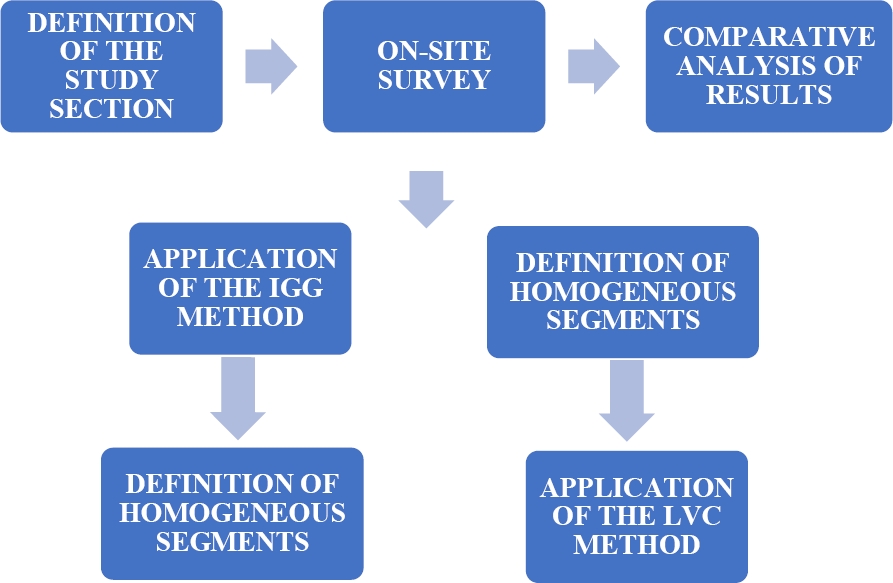
Figure 1. Research steps.
The section studied is located on Highway BR-222, between Forquilha and Fortaleza, Km 208 and Km 209, making a total of 2 km. The highway analyzed has a single lane, with two traffic lanes, and its surface is asphalt. The choice of the highway is justified by the heavy traffic, especially on weekdays, in addition to being the main transport route that connects the city of Forquilha to the capital of the state of Ceará, Fortaleza.
The LVC method was carried out at an average speed of 30 to 40 km/h, at which it was possible to record the distress found on the highway. To do this, the two technicians used a spreadsheet to record the occurrence of distress on the pavement surface, with the track divided into four segments of 500m each, according to DNIT (2003b). Segments 1 and 2 correspond to kilometer 208 and Segments 3 and 4 correspond to kilometer 209. Based on the field survey, it was possible to determine the value of the Flexible and Semi-Rigid Pavement Condition Index (ICPF), as well as the calculation of the Expedite Global Severity Index (IGGE) and the Surface State Index (IES).
When applying the IGG, a marking was established every alternate 20 meters in relation to the axis of the roadway, as the stretch under study is a simple lane. Six segments were used, using as criteria the homogeneity of distresses and wheel track sags. Regarding the measurement of wheel track depressions, a standardized aluminum truss was used, with a central movable rod that has the capacity to measure with precision of up to 0.5mm, according to DNIT (2003a).
DNIT (2003b) defines that for each classification there is an intervention alternative. Based on this information, the costs associated with each maintenance and rehabilitation (M&R) activity of the analyzed highway were calculated using the Road Cost System (SICRO) and the Average Management Cost Reports. These systems were developed by the National Department of Transport Infrastructure (DNIT) and follow the guidelines established in (DNIT, 2003c).
In this study, the price compositions contained in the SICRO Nordeste Report for the state of Ceará, referring to the database for the month of October/2022 (DNIT, 2022) and in the Average Management Cost Report for July/2017 were taken into consideration (DNIT, 2017). According to (DNIT, 2006), the recommended thicknesses for the asphalt coating are between 5 and 12.5 cm, and the maximum and minimum thicknesses for compacting the granular layers are 20 cm and 10 cm, respectively. Based on these criteria, the calculated costs related to M&R activities in the analyzed sections considered a thickness of 5 cm for the asphalt concrete coating and 15 cm thickness for granular layers. Based on the costs obtained, it is possible to compare the values of M&R interventions between the methods studied.
After the in situ analyzes and with the completed forms, the results obtained were analyzed to determine the functional condition of the pavement according to the two methodologies applied. The state of conservation of the pavement, determined by the two methods, was compared with each other, aiming to analyze the technical differences between LVC and IGG, with the aim of verifying the divergences between an objective and a subjective assessment and the respective costs.
4. ANALYSIS AND DISCUSSION OF RESULTS
In relation to LVC, it was observed that the selected sections presented different types of distresses such as isolated cracks, alligator-skin-like cracks, wheel track sags, ripples and exudation, the score of which resulted in an ICPF varying from 2 to 4 according to Tab (3). Stretches 3 and 4 have a high IGGE, thus demonstrating their critical condition with regard to distresses of the type: potholes and patches. Figure 2 demonstrates the distresses found in the analyzed stretch section of the BR-222 Highway.
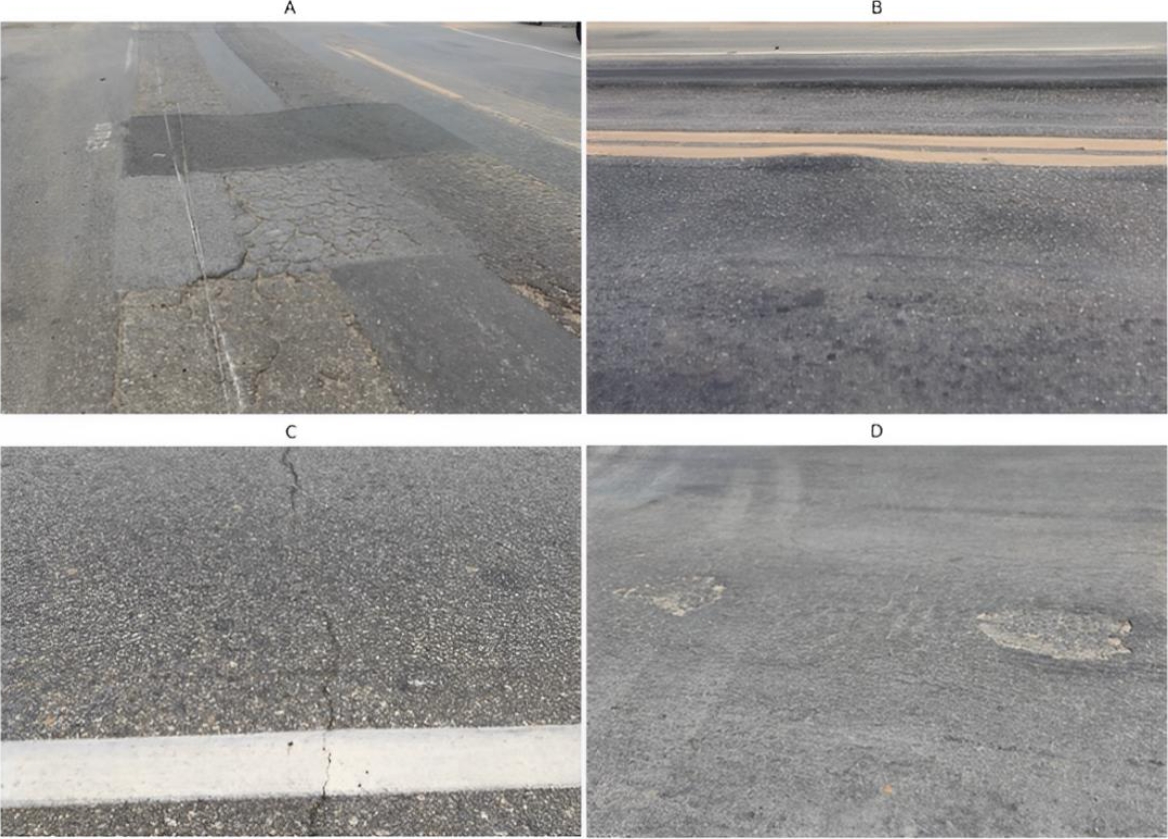
Figure 2. Main distresses found on Highway BR-222: (a) patches and alligator cracks (b) settlements (c) transversal crack (d) potholes and outworning
With the ICPF and IGGE it was possible to determine the IES and classify the pavement according to its state of conservation. The results are summarized in Table 2. With the breakdown of the individual 500m segments.
Table 2. Summary of LVC results – Highway BR-222 (Km 208 and Km 209).
| Segments | Results | IES | |||
| ICPF | IGGE | Value | Classification | ||
| Km 208 | 1 (500 m) | 4 | 0 | 0 | Excellent |
| 2 (500 m) | 3 | 10,4 | 2 | Good | |
| Km 209 | 3 (500 m) | 2 | 83,2 | 8 | Very poor |
| 4 (500 m) | 2 | 89,4 | 8 | Very poor | |
The results observed in Table 2 showed that segments 1 and 2 presented an Excellent and Good classification, respectively, while segments 3 and 4 presented a Poor status, given the high number of distresses in the pavement.
In relation to the IGG, the results found with the respective classifications are presented in Table 3, which contains the values of the six homogeneous segments between Km 208 and Km 209 of the studied highway.
Table 3. Summary of IGG results – Highway BR-222 (Km 208 and Km 209).
| Segments | Results | ||
| IGG | Classification | ||
| Km 208 | 1 (240 m) | 55 | Fair |
| 2 (260 m) | 25 | Good | |
| 3 (500 m) | 65 | Fair | |
| Km 209 | 4 (240 m) | 141 | Poor |
| 5 (500 m) | 162 | Very poor | |
| 6 (260 m) | 126 | Poor | |
It was verified that the results obtained in the IGG indicate that none of the sections presented an Excellent classification, only Segment 2 presented a Good classification, with exudation and patches in five stations. Segments 1 and 3 presented a Fair classification, the most constant distress in Segment 1 was the exudation found in all stations, with no isolated cracks or fissures being located, while Segment 3 mainly has the presence of type 1 cracks, 2 and 3. Segments 4 and 6 were classified as Poor, both segments had defects such as sinking, cracks and patches. The only segment classified as Very poor is 5, in which defects such as pans, slipping, patches, cracks, sinking and wear were found. The causes of these distresses may be associated with executive failures, differential settlements or the action of heavy vehicle traffic itself.
Furthermore, we sought to make a comparison between the evaluation using the two methods, with emphasis on the functional condition of the evaluated highway and the defects found in the pavement. To this end, Figure 3 shows a classification scheme for sections according to the method used.
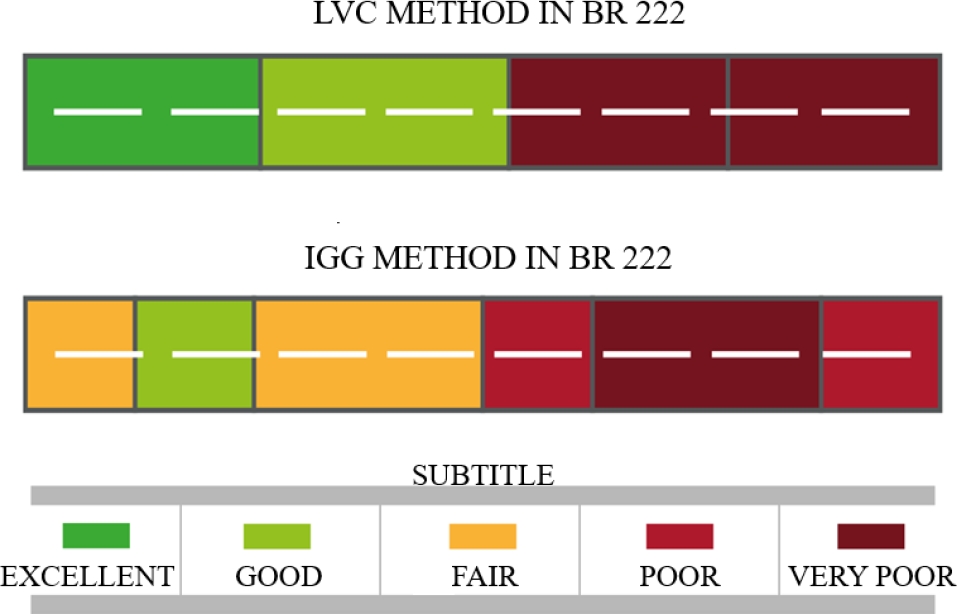
Figure 3. Comparison of LVC and IGG method classifications.
It is observed that the divergences between the methods are found in their subjective or objective form. The IGG is an evaluation considered to be a sample, in which the distresses found in the stations of the chosen section are analyzed. In turn, the LVC is carried out continuously, checking for distresses along the entire highway, briefly due to the speed of the vehicle, leaving room for errors on the part of the evaluating technicians. From this you can understand that due to these differences there are different classifications for the specific segments in this study.
Regarding the condition of the pavement, both methods classified the segments of km 209 as Poor or Very Poor, showing that, despite the LVC method being subjective, a worse surface condition can be more easily identified by residents, due to the presence of a greater quantity of distresses. Regarding segment 2, the IGG method classified it as Good, while the LVC method classified it as Excellent.
Several authors have carried out comparative studies between methods for assessing the condition of pavements, whether objective or subjective (VIEIRA et al. 2016, CAVALCANTE et al. 2018, SILVA et al. 2018a, FERNANDES et al. 2018, SOUSA et al. 2022). These studies showed that each approach has its advantages and advantages, contributing to the understanding of the functional state of road pavements. It is noteworthy that, due to the different approaches and focuses in evaluations, the methods can be effectively complementary. While some methods provide a quantitative (objective) analysis, others provide a qualitative (subjective) analysis.
The combination of these approaches helps fill gaps, resulting in a more comprehensive assessment of the pavement condition. Therefore, choosing the most appropriate method will depend on the specific characteristics of each situation, as well as its limitations. The integration of different methods can strengthen the reliability of assessments.
In Table 4, we sought to present alternatives for maintenance and rehabilitation interventions (M&R) according to the classification of each segment analyzed. In addition, the M&R costs for each of the proposed interventions are also represented.
Table 4. Intervention alternatives and M&R costs.
| Classification | M&R Alternatives | Unit Costs | Cost (R$/ Km) | |
| Excellent | Do nothing | - | - | 0,00 |
| Good | Application of slurry seal | 1,14 | R$/m² | 8.208,00 |
| Fair | Correcting located spots | 111,26 | R$/m³ | 40.053,60 |
| Poor | Restoration | 833,33 | R$/m³ | 1.200.000,00 |
| Very poor | Reconstruction | 1.620,83 | R$/m³ | 2.334.000,00 |
| Source: Adapted from DNIT Standard (2003b), DNIT (2022), DNIT (2017) |
The difference in pavement conservation status classification results in different M&R strategies and costs. In this sense, the IGG method, as it is an objective method, may be able to classify the condition of the pavement with better precision, since it is independent of the evaluator's opinion. Similar results were found by Silva et al. (2018a). Table 5 shows a comparison of values between the two methods.
Table 5. Costs of M&R alternatives and field survey labor.
| LCV | IGG | ||||||
| Seg. | Clas. | Ext. (m) | Costs (R$) | Seg. | Clas. | Ext. (m) | Costs (R$) |
| 1 | Excellent | 500 | 0,00 | 1 | Fair | 240 | 9.612,86 |
| 2 | Good | 260 | 2.134,08 | ||||
| 2 | Good | 500 | 4.104,00 | 3 | Fair | 500 | 20.026,80 |
| 3 | Very poor | 500 | 1.167.000,00 | 4 | Poor | 240 | 288.000,00 |
| 5 | Very poor | 500 | 1.167.000,00 | ||||
| 4 | Very poor | 500 | 1.167.000,00 | 6 | Poor | 260 | 312.000,00 |
| Labor cost | 520,00 | Labor cost | 620,00 | ||||
| Total cost (R$): | 2.338.624,00 | Total cost (R$): | 1.799.393,74 | ||||
It can be seen that LVC had a total cost higher than IGG by around 30%. The LVC classified km 209 as Poor, for which DNIT (2003b) recommends the reconstruction of the segment, making R$ 2,334,000.00 necessary for the rehabilitation of the final segments of the analyzed section. The lowest costs of R$ 2,134.08 and R$ 4,104.00 were in Segment 2 in both methods, where only the application of asphalt mud is required. At IGG, the highest M&R cost is in Segment 5, totaling R$ 1,167,000.00, where reconstruction of the section is also necessary.
To integrate the two methods in a complementary way, maintenance and rehabilitation costs were calculated in the segments considering the most unfavorable classification (Fair, Poor or Very poor) between the LVC and the IGG. In this context, when considering the worst classification scenario, the total value of R$ 2,365,773.74 is obtained. It is observed that, in relation to the highest cost method (LVC), the difference in the complement of the methods is R$ 27,149.74 for the segments evaluated.
Regarding the costs associated with surveys, when considering only the labor costs responsible for field services, the execution of the LVC resulted in the allocation of one daily rate for the technician and another for the driver. As stipulated by DNIT (2021), these daily rates represent a cost of R$310.00 and R$210.00, respectively, totaling R$520.00. On the other hand, at IGG, it took two days for the technician, resulting in a total of R$ 620.00.
The Continuous Visual Survey (LVC) showed that Km 208 is in better conditions than Km 209, as Segments 1 and 2 received ratings of Excellent and Good, respectively, representing 50% of the analyzed section, while Segments 3 and 4 also represented 50%. % received a rating of Poor. The Global Severity Index (IGG) showed that the segments of km 208 were classified as Fair and Good, however the segments of Km 209 were classified as Poor and Very Poor, confirming that Km 208 is in a better state of pavement conservation asphalt.
LVC has an advantage over IGG in terms of execution time, which lasted approximately 3 hours to determine the Expedited Global Gravity Index (IGGE), the Flexible and Semi-Rigid Pavement Condition Index (ICPF) and the Surface Condition Index (IES) of the highway, and a disadvantage associated with the fact that this method does not consider all defects, it only considers cracks, deformations, pans and patches. In the Global Severity Index, there is the advantage that the method covers a greater variety of distresses and is carried out on foot, in which the evaluator can actually visualize and verify the distresses present on the road. However, regarding its duration, it took around 12 hours to collect data from the analyzed stretch, thus requiring more time from the evaluators.
The IGG contributes to a detailed assessment by being objective. It provides parameters for the surface condition of the pavement, generating an inventory of the occurrence of distresses through forms and classification of stretch sections. Finally, both methods are essential for understanding distresses in the pavement, which makes it possible to act to minimize these problems.
5. CONCLUSION
This research aimed to make a comparison between two methods for evaluating surface distresses on road pavements, a subjective method and an objective method, respectively, the Continuous Visual Survey (LVC) and the Global Severity Index (IGG). The classifications of the segments of the chosen stretch were compared, as well as it was possible to compare intervention alternatives and M&R costs.
There were differences regarding the functional classification of the same segment between the two assessment methods. The LVC presented the two initial segments with Good and Excellent classification, while the final segments were classified as Very Poor, due to the large number of distresses identified. In IGG, only one segment was classified as Good, two segments were classified as Fair and the final half of the analyzed stretch received ratings of Poor and Very Poor.
Regarding maintenance and rehabilitation costs, it can be seen that the LVC presented the need for a higher cost in relation to the IGG, due to the classification of the final segments that indicate the need for reconstruction of the highway.
It is known that different classifications of the functional state of the pavement require different M&R strategies and resources. Therefore, the most appropriate survey method must be selected considering aspects such as survey cost and time, materials and personnel required, among others. Furthermore, IGG, as it is an objective method, can be more accurate in classifying the state of conservation of the pavement, as it quantifies existing distresses, without depending on the opinion of evaluators, like LVC.
In this sense, it is important to highlight that the complementarity between IGG and LVC can be strategic. While IGG offers a quantitative (objective) approach, providing specific data about distresses, LVC contributes a qualitative (subjective) assessment, visually identifying a variety of distresses. The combination of these methods can provide a more comprehensive view of the pavement condition, allowing for more rational decision-making when defining M&R strategies. Therefore, the choice between IGG and LVC, or even their combined application, will depend on the specific needs of the pavement assessment in question.
6. REFERENCES
Cavalcante, R. L., Fernandes Junior, J. L., Suárez, D. A. A. (2018), Análise Comparativa Entre Métodos de Levantamento de Defeitos em Pavimentos Flexíveis: Estudo de Caso na BR 060/MS. 46 ªed. Revista Pavimentação. 14 (1): 52-70.
Confederação Nacional do Trasnporte. (2022), Pesquisa CNT Rodovias. Relatório gerencial.
Departamento Nacional de Infraestrutura de Transportes. (2003a). DNIT 006/2003 - PRO: Avaliação objetiva da superfície de pavimentos flexíveis e semi-rígidos - Procedimento. Rio de Janeiro.
Departamento Nacional de Infraestrutura de Transportes. (2003b). DNIT 008/2003 - PRO: Levantamento visual contínuo para avaliação da superfície de pavimentos flexíveis e semi-rígidos - Procedimento. Rio de Janeiro.
Departamento Nacional de Infraestrutura de Transportes. (2003c) Diretoria Executiva. Coordenação-Geral de Custos de Infraestrutura de Transportes. Manual de Custos de Infraestrutura de Transportes. Volume 01: Metodologia e Conceitos - 3ª Edição - Brasília.
Departamento Nacional de Infraestrutura de Transportes. (2006). Manual de Restauração de Pavimentos Asfálticos. Diretoria Executiva. Instituto de Pesquisas Rodoviárias. Rio de Janeiro.
Departamento Nacional de Infraestrutura de Transportes. (2017). CMG: Custos Médios Gerenciais. Disponível em: copy_of_anexoixcustomdiogerencialjulho2017.pdf (https://www.gov.br). Acesso em: 19 jan. 2023.
Departamento Nacional de Infraestrutura de Transportes. (2021). Relatório de Consolidação dos Custos de Mão de Obra. Tabela de Preços de Consultoria - mês de referência: outubro de 2021.
Departamento Nacional de Infraestrutura de Transportes. (2022). Sistema de Custos Referenciais de Obras - SICRO. Relatório Sintético de Composições de Custos CE, outubro/2022.
Espíndola, A. C., Silva, C. A. U., Nobre Junior, E. F., Romeiro Junior, C. L. S. (2018). “Avaliação Funcional da Rodovia BR-104/AL-Trecho Urbano Da Cidade De Maceió/AL” in: Anais do 32º Congresso de Pesquisa e Ensino em Transportes da ANPET, Gramado (Brasil), pp. 1398-1409.
Fernandes, P. G. P. S., Carvalho, P. H. F. C., Nobre Júnior, E. F., Oliveira, F. H. L. (2018). “Avaliação das condições de superfície de pavimentos rodoviários por meio do VSA e do IRI obtido por aplicativo para smartphones”. in: Anais do 32° Congresso de Ensino e Pesquisa em Transportes (ANPET), Gramado, Santa Catarina, pp. 1212-1221.
Lira, M. N., Oliveira, F. H. L. (2019). “A Influência das Avaliações Objetiva e Subjetiva na Manutenção e Reabilitação de Rodovias Brasileiras” in: XX Congresso Ibero-Latino-Americano do Asfalto. Anais do Congresso Ibero-Latino-Americano do Asfalto, Guadalajara (México), pp. 1-10.
Marcolan, C. M., Klamt, R. A., Knierim, L. S. (2020), Avaliação das Condições Funcionais de um Pavimento para Soluções de Restauração. Revista de Engenharia e Tecnologia. 12 (2):149-160. ISSN 2176-7270.
Moura, M. A. S. (2017) “Avaliação de Manifestações Patológicas na TO-164 entre os Municípios De Xambioá e Araguanã-TO”. Trabalho de Conclusão de Curso, Centro Universitário Luterano de Palmas.
Santos, D. C. M. F., Silva Júnior, F. V. (2018), Levantamento Visual Contínuo: Análise da Rodovia TO-255, trecho de Porto Nacional a Monte do Carmo. Engineering Sciences. 6 (1):10-20. https://doi.org/10.6008/CBPC2318-3055.2018.001.0002
Santos, T. S. P. (2014), “Comparação do método DNIT 006/2003 com Solução Alternativa para Determinação do Índice de Gravidade Global (IGG): avaliação de trecho da PE-95 Caruaru-Limoeiro”. Trabalho de Conclusão de Curso, Universidade Federal de Pernambuco.
Santos, Y. R. P., Barbosa, C. E. B., Lima, J. J., Meneses, M. M. M., Nascimento, P. D. L. (2021), Classificação e Diagnóstico do Estado de Conservação de uma Via em Pavimentação Asfáltica do Município de Caruaru, Pernambuco, Brasil.Research, Society and Development. 10 (17): 1-12. https://doi.org/10.33448/rsd-v10i17.24257.
Silva, J. P. O., Oliveira, F. H. L., Araújo, C. B. C. (2018a) Análise Funcional Comparativa de Trecho da BR-116 no Estado do Ceará. Revista Tecnologia. 39 (2): p. 1-21. https://doi.org/10.5020/23180730.2018.7427.
Silva, R. C., Motta, L. M. G., Vianna, K. K. L., Souza Junior, J. G., Costa, D. P. (2018b) Levantamento Visual Contínuo Informatizado (LVCI) Pelo Método da Varredura - Comparação com Outros Métodos. Revista Estradas. 23 (1): 64-70.
Silva, S. O., Chaves, J. W. R., Almeida, L. C., Oliveira, F. H. L. (2022). “Avaliação Funcional De Vias Urbanas Por Meio Do Índice De Gravidade Global (IGG) -Estudo De Caso No Município De Caucaia-Ce”. in: Anais do 24º Encontro Nacional de Conservação Rodoviária (ENACOR)/47ª Reunião Anual de Pavimentação (RAPv), pp. 1011-1021.
Soncim, S. P., Fernandes Júnior, J. L. (2015), Modelo de Previsão do Índice de Condição dos Pavimentos Flexíveis.Journal of Transport Literature, 9 (3):25-29. https://doi.org/10.1590/2238-1031.jtl.v9n3a5
Sousa, J. L. C., Batista, J. C., Bastos, S. D. V., Nascimento, N. V., Barcelos, P. F., Ramos, S. P., Brasileiro, F. L. C. (2022), Avaliação da superfície de pavimentos flexíveis pelos métodos do IGG e LVC: na BR 222 (Trecho Forquilha- Fortaleza). Brazilian Journal of Development. 8(5): 36507-36519. DOI: https://doi.org/10.34117/bjdv8n5-250.
Vieira, S. A., Pinho Júnior, A. A. E., Oliveira, F. H. L., Aguiar, M. F. P. (2016), Análise Comparativa de Metodologias de Avaliação de Pavimentos Através do IGG e PCI. Conexões - Ciência e Tecnologia, 10(3):20-30. ISSN 2176-0144. https://doi.org/10.21439/conexoes.v10i3.799.